Thursday, February 2, 2012


Wikipedia Favorite: The Paradox of Choice: Why More Is Less
The Paradox of Choice - Why More Is Less is a 2004 book by American psychologist Barry Schwartz. In the book, Schwartz argues that eliminating consumer choices can greatly reduce anxiety for shoppers. This same issue was first proposed by José Ortega y Gasset in Chapter 4 of his book The Revolt of the Masses.
Schwartz assembles his argument from a variety of fields of modern psychology that study how happiness is affected by success or failure of goal achievement.
Schwartz maintains that it is precisely so that we can focus on our own wants that all of these choices emerged in the first place...
Why we suffer
Schwartz integrates various psychological models for happiness showing how the problem of choice can be addressed by different strategies. What is important to note is that each of these strategies comes with its own bundle of psychological complication.
Barry Schwartz's thesisAutonomy and Freedom of choice are critical to our well being, and choice is critical to freedom and autonomy. Nonetheless, though modern Americans have more choice than any group of people ever has before, and thus, presumably, more freedom and autonomy, we don't seem to be benefiting from it psychologically.—quoted from Ch.5, The Paradox of Choice, 2004Barry Schwartz's thesisSchwartz assembles his argument from a variety of fields of modern psychology that study how happiness is affected by success or failure of goal achievement.
Schwartz assembles his argument from a variety of fields of modern psychology that study how happiness is affected by success or failure of goal achievement.
[edit] When we choose
Schwartz compares the various choices that Americans face in their daily lives by comparing the selection of choices at a supermarket to the variety of classes at an Ivy League college.| “ | There are now several books and magazines devoted to what is called the "voluntary simplicity" movement. Its core idea is that we have too many choices, too many decisions, too little time to do what is really important. [...] Taking care of our own "wants" and focusing on what we "want" to do does not strike me as a solution to the problem of too much choice.[1] | ” |
Schwartz maintains that it is precisely so that we can focus on our own wants that all of these choices emerged in the first place...
Why we suffer
Schwartz integrates various psychological models for happiness showing how the problem of choice can be addressed by different strategies. What is important to note is that each of these strategies comes with its own bundle of psychological complication.
- Choice and Happiness. Schwartz discusses the significance of common research methods that utilize a Happiness Scale. He sides with the opinion of psychologists David Myers and Robert Lane, who independently conclude that the current abundance of choice often leads to depression and feelings of loneliness. Schwartz draws particular attention to Lane's assertion that Americans are paying for increased affluence and freedom with a substantial decrease in the quality and quantity of community. What was once given by family, neighborhood and workplace now must be achieved and actively cultivated on an individual basis. The social fabric is no longer a birthright but has become a series of deliberated and demanding choices. Schwartz also discusses happiness with specific products. For example, he cites a study by Sheena Iyengar of Columbia University and Mark Lepper of Stanford University who found that when participants were faced with a smaller rather than larger array of chocolates, they were actually more satisfied with their tasting.
- Freedom or Commitment. Schwartz connects this issue to economist Albert Hirschman's research into how populations respond to unhappiness: they can exit the situation, or they can protest and voice their concerns. While free-market governments give citizens the right to express their displeasure by exit, as in switching brands, Schwartz maintains that social relations are different. Instead, we usually give voice to displeasure, hoping to project influence on the situation.
- Second-Order Decisions. Law professor Cass Sunstein uses the term "second-order decisions" for decisions that follow a rule. Having the discipline to live "by the rules" eliminates countless troublesome choices in one's daily life. Schwartz shows that these second-order decisions can be divided into general categories of effectiveness for different situations: presumptions, standards, and cultural codes. Each of these methods are useful ways people use to parse the vast array of choices they confront.
- Missed Opportunities. Schwartz finds that when people are faced with having to choose one option out of many desirable choices, they will begin to consider hypothetical trade-offs. Their options are evaluated in terms of missed opportunities instead of the opportunity's potential. Schwartz maintains that one of the downsides of making trade-offs is it alters how we feel about the decisions we face; afterwards, it affects the level of satisfaction we experience from our decision. While psychologists have known for years about the harmful effects of negative emotion on decision making, Schwartz points to recent evidence showing how positive emotion has the opposite effect: in general, subjects are inclined to consider more possibilities when they are feeling happy.
Global Warming: The Un-tellable Story
by Rebecca Novick/Huffington Post/Feb. 1, 2012
--------------------------
The following is a transcript of a talk by British biologist Dr. John Stanley based on an interview with Rebecca Novick. It was presented at the Global Buddhist Congregation in New Delhi, Nov. 29, 2011. Dr. Stanley is co-author of A Buddhist Response to the Climate Emergency and runs the blog, Ecological Buddhism.
WHAT DO WE KNOW ABOUT GLOBAL WARMING?
We know that 80 percent of global warming is caused by fossil fuels and 20 percent of it is caused by deforestation. This simple piece of information seems to have become very obscured. Why is there so much obscurity around this issue? And how much of that obscurity is due to the attitude or the fault of the individual, and how much of it is actually socially engineered? How much of it reflects the large amounts of money spent on public relations and advertising by the big fossil fuel corporations with the intention of casting doubt on the climate science?
For the last 10,000 years we've been living in a geological era called the Holocene. And it came at the end of a long period of ice ages. Human civilization and agriculture has developed within this benign mild climatic period, which has been very good to us. These geological climatic periods are governed by the carbon cycle of the planet and the primary factor that governs them is the atmospheric concentrations of carbon dioxide. In most of the Holocene this concentration has been between 280 parts per million and 350 parts per million as the upper limit.
Since the industrial revolution, humans have been releasing into the atmosphere fossil carbon dioxide, which was fixed way back in the Carboniferous period, a couple of hundred million years ago, and this has been extracted as oil and coal and we burn it. So right now in 2011 its 393 parts per million; 43 parts per million over the upper limit of the last 10,000 years. This means that we've entered a new geological era, which the Nobel Prize winning atmospheric chemist Paul Crutzen has coined the Anthropocene from 'anthropos' the Greek for 'man'. It means that humans are now the primary geological agent on the planet. We are now fundamentally altering the carbon cycle of the planet. This has been amplified by our increasing population and consumerism. People's carbon footprint is essentially being dictated by advertising and the manufacture of desire. That's a real sucker punch we're delivering to the climate system, and it's inconceivable that we're going to get away with it.
Read more at Huffington Post
--------------------------
The following is a transcript of a talk by British biologist Dr. John Stanley based on an interview with Rebecca Novick. It was presented at the Global Buddhist Congregation in New Delhi, Nov. 29, 2011. Dr. Stanley is co-author of A Buddhist Response to the Climate Emergency and runs the blog, Ecological Buddhism.
WHAT DO WE KNOW ABOUT GLOBAL WARMING?
We know that 80 percent of global warming is caused by fossil fuels and 20 percent of it is caused by deforestation. This simple piece of information seems to have become very obscured. Why is there so much obscurity around this issue? And how much of that obscurity is due to the attitude or the fault of the individual, and how much of it is actually socially engineered? How much of it reflects the large amounts of money spent on public relations and advertising by the big fossil fuel corporations with the intention of casting doubt on the climate science?
I think that the key factor in this whole issue is the social psychology. The consensus among climate scientists is very strong. The effort is massive and we have 99.95 percent consensus, and yet there's this doubt, which is both sad and interesting.THE ANTHROPOCENE: A NEW GEOLOGICAL ERA
For the last 10,000 years we've been living in a geological era called the Holocene. And it came at the end of a long period of ice ages. Human civilization and agriculture has developed within this benign mild climatic period, which has been very good to us. These geological climatic periods are governed by the carbon cycle of the planet and the primary factor that governs them is the atmospheric concentrations of carbon dioxide. In most of the Holocene this concentration has been between 280 parts per million and 350 parts per million as the upper limit.
Since the industrial revolution, humans have been releasing into the atmosphere fossil carbon dioxide, which was fixed way back in the Carboniferous period, a couple of hundred million years ago, and this has been extracted as oil and coal and we burn it. So right now in 2011 its 393 parts per million; 43 parts per million over the upper limit of the last 10,000 years. This means that we've entered a new geological era, which the Nobel Prize winning atmospheric chemist Paul Crutzen has coined the Anthropocene from 'anthropos' the Greek for 'man'. It means that humans are now the primary geological agent on the planet. We are now fundamentally altering the carbon cycle of the planet. This has been amplified by our increasing population and consumerism. People's carbon footprint is essentially being dictated by advertising and the manufacture of desire. That's a real sucker punch we're delivering to the climate system, and it's inconceivable that we're going to get away with it.
Read more at Huffington Post
Climate scientists not cowed by relentless climate change deniers
by Toni Feder/Physics Today/Bolume 65/Issue 2
-------------------
Groups that provide moral support, legal counsel, and swift rebuttals of misinformation are sprouting up.
-------------------
Groups that provide moral support, legal counsel, and swift rebuttals of misinformation are sprouting up.
Receiving an email with a statement like “You should resign, and if you don’t, I’ll work to see that you are fired” or “I know where your kids go to school” would be unsettling enough. But they “pale compared to what other climate scientists are getting,” says Raymond Orbach, director of the Energy Institute at the University of Texas at Austin, at whom the first threat above was aimed.
Now climate scientists—in atmospheric physics and chemistry, geophysics, meteorology, hydrology, and oceanography, among other disciplines—have begun to fight back. “I think the community is finding a voice,” says Ben Santer of Lawrence Livermore National Laboratory, whose work has largely focused on identifying the human influence on global climate, and who once answered a late-night knock to find a dead rat on his doorstep.
Climate scientists overwhelmingly agree that climate change is happening, although details of how it will play out are uncertain. Every few years, the Intergovernmental Panel on Climate Change (IPCC) issues a report prepared by hundreds of scientists and government officials from around the world; the next is due out in 2014. The latest, published in 2007, says that warming of the climate system is unequivocal, that most of the observed increase in globally averaged temperatures since the mid 20th century is due to human activities, and that past and future anthropogenic carbon dioxide emissions will contribute to warming and sea-level rise for more than a millennium. Yet deniers have hampered efforts to tackle climate change, and their actions, especially in North America, the UK, and Australia, have led to climate researchers being investigated by their governments, suffering nervous breakdowns, and spending time and money defending their rights and reputations.
Read more at Physics Today
Wikipedia Favorite: Overchoice
Overchoice, also referred to as "choice overload",[1] is a term describing a problem facing consumers in the postindustrial society: too many choices.[2] The term was first introduced by Alvin Toffler in his 1970 book, Future Shock.[2][3][4][5][6]
Overchoice is the result of technological progress. Since the beginning of the Industrial Revolution, each year, more and more products are being offered.[3][4] Consumers have more disposable income to spend, and producers can more easily and cheaply introduce product variations.[3]
Having more choices, on the surface, appears to be a positive development; however it hides an underlying problem: faced with too many choices, consumers have trouble making optimal choices, and thus as a result can be indecisive, unhappy, and even refrain from making the choice (purchase) at all.[3][5][7][8] Alvin Toffler noted that as the choice turns to overchoice, "freedom of more choices" ironically becomes the opposite—the "unfreedom". Often, a customer makes a decision without sufficiently researching his choices, which may often require days.[7]
Existence of overchoice, both perceived and real, was confirmed by studies as early as the mid-1970s.[3][7] Numbers of various brands, from soaps to cars, have been steadily rising for over half a century.[7] In just one example—different brands of soap and detergents—the numbers of choices offered by an average US supermarket went from 65 in 1950, through 200 in 1963, to over 360 in 2004. The more choices one has, the slower one is to make decisions.[7]
Opposites of overchoice (sometimes referred to as underchoice) include standardization.[7]
Read more at Wikipedia
Overchoice is the result of technological progress. Since the beginning of the Industrial Revolution, each year, more and more products are being offered.[3][4] Consumers have more disposable income to spend, and producers can more easily and cheaply introduce product variations.[3]
Having more choices, on the surface, appears to be a positive development; however it hides an underlying problem: faced with too many choices, consumers have trouble making optimal choices, and thus as a result can be indecisive, unhappy, and even refrain from making the choice (purchase) at all.[3][5][7][8] Alvin Toffler noted that as the choice turns to overchoice, "freedom of more choices" ironically becomes the opposite—the "unfreedom". Often, a customer makes a decision without sufficiently researching his choices, which may often require days.[7]
Existence of overchoice, both perceived and real, was confirmed by studies as early as the mid-1970s.[3][7] Numbers of various brands, from soaps to cars, have been steadily rising for over half a century.[7] In just one example—different brands of soap and detergents—the numbers of choices offered by an average US supermarket went from 65 in 1950, through 200 in 1963, to over 360 in 2004. The more choices one has, the slower one is to make decisions.[7]
Opposites of overchoice (sometimes referred to as underchoice) include standardization.[7]
Read more at Wikipedia
Wednesday, February 1, 2012
The Cause of Global Warming from a Christian Perspective
Pandango: I can't make this stuff up. I don't know whether to laugh or cry.
--------------------
by William Van Amber Fields/Lodi News-Sentinel/Jan. 28, 2012
Cause of global warming controversy? Ignoring Bible
The primary cause of the conflict in the global warming debate is not the observation that carbon dioxide has increased in the atmosphere or that a small amount of warming has occurred, but rather that the Bible has been rejected as a source of important revelation about Earth history.
The biblical revelation of a global flood occurring only a few thousand years ago is certainly an important and significant event to ignore.
Holy Scripture assures us that "while the Earth remains, seed time and harvest, cold and heat, summer and winter, and day and night shall not cease (Genesis 8:22)."
Read more at Lodi News-Sentinel
--------------------
by William Van Amber Fields/Lodi News-Sentinel/Jan. 28, 2012
Cause of global warming controversy? Ignoring Bible
The primary cause of the conflict in the global warming debate is not the observation that carbon dioxide has increased in the atmosphere or that a small amount of warming has occurred, but rather that the Bible has been rejected as a source of important revelation about Earth history.
The biblical revelation of a global flood occurring only a few thousand years ago is certainly an important and significant event to ignore.
Holy Scripture assures us that "while the Earth remains, seed time and harvest, cold and heat, summer and winter, and day and night shall not cease (Genesis 8:22)."
Read more at Lodi News-Sentinel
Price Of Truth: Limbaugh Operatives Encourage Abusive Hate Mail At Female, Evangelical Climate Scientist | ThinkProgress
Pandango: The sheer hate embodied in a little fat man sitting behind the golden microphone of the EIB network.
Price Of Truth: Limbaugh Operatives Encourage Abusive Hate Mail At Female, Evangelical Climate Scientist ThinkProgress
Price Of Truth: Limbaugh Operatives Encourage Abusive Hate Mail At Female, Evangelical Climate Scientist ThinkProgress
Pants on Fire Chain E-Mail: The Light Bulb Police
by PolitiFact/May 16, 2011
-----------------------
Conservative group claims new law would require people to throw away existing light bulbs and replace with more efficient ones
A fundraising letter making the rounds from a conservative political action committee draws a political line in the sand over light bulbs.
-----------------------
Conservative group claims new law would require people to throw away existing light bulbs and replace with more efficient ones
A fundraising letter making the rounds from a conservative political action committee draws a political line in the sand over light bulbs.
The letter, circulated by AmeriPAC, a political action committee that largely supports conservative Republican candidates, claims President Barack Obama is "banning" incandescent light bulbs in favor of compact fluorescent lighting. It includes a lengthy letter purported to be written by Ron Arnold of the Center for the Defense of Free Enterprise Action Fund.
"A silly little light bulb is merely a small piece of the larger puzzle of global socialism that he feels is his agenda to enslave the American people -- and to choke Americans from a free enterprise system!" the letter states.
The letter seeks contributions and support for S.B. 395, the Better Use of Light Bulbs (BULB) Act, sponsored by Sen. Mike Enzi, R-Wyo., which seeks to repeal the light bulb efficiency standards included in the Energy Independence and Security Act of 2007.
We're writing about several claims in the letter, but here, we wanted to set the record straight on one of its worst inaccuracies.
"Next year your light bulbs will be obsolete," the letter reads. "You will be mandated by federal law to get rid of your existing light bulbs."
A few paragraphs later, the letter hits on the same idea, stating, "Next year you will be required to trade in -- whoops...throw away...your trusty incandescent light bulbs so you will supposedly be 'environmentally-safe' with much more expensive Compact Fluorescent Light Bulbs (CFLs)."
Sec. 321 of the Energy Independence and Security Act of 2007 spells out the new standards for light bulbs, essentially requiring them to be 25 percent more efficient. The idea is that, over time, more efficient light bulbs will replace older, less efficient ones.
Read more at PolitiFact
Pants on Fire Chain E-Mail about Obama's Healthcare Plan: Medicare monthly premiums will go up to $104.20 in 2012 and $247.00 in 2014 due to "provisions incorporated in the Obamacare legislation, purposely delayed so as not to 'confuse' the 2012 re-election campaigns."
by PolitiFact/Sep. 24, 2011
-------------------------
Medicare premiums going up due to “Obamacare”? Chain e-mail gets it wrong
A chain e-mail going around warns of a Medicare premium increase, saying monthly premiums will go up from $96.40 to $247 in 2014. Blame it all on "Obamacare," the e-mail says.
Here’s the full text of the copy we received:
MEDICARE PREMIUM INCREASE
For those of you who are on Medicare, read the article below. It's a
short but important article that you probably haven't heard about in
the mainstream news:
The per person Medicare insurance premium will increase from the
present monthly fee of
$ 96.40, rising to:
$104.20 in 2012;
$120.20 in 2013; And
$247.00 in 2014.
These are provisions incorporated in the Obamacare legislation,
purposely delayed so as not to 'confuse' the 2012 re-election
campaigns.
Send this to all seniors that you know, so they will know who's
throwing them under the bus.
We decided to fact-check this chain e-mail, which we soon found has been floating around the Internet in one version or another since at least 2009.
As we researched, we quickly realized two important points. First, the chain e-mail’s numbers are wrong. Second, explaining Medicare premiums is pretty complicated.
Read more at PolitiFact
-------------------------
Medicare premiums going up due to “Obamacare”? Chain e-mail gets it wrong
A chain e-mail going around warns of a Medicare premium increase, saying monthly premiums will go up from $96.40 to $247 in 2014. Blame it all on "Obamacare," the e-mail says.
Here’s the full text of the copy we received:
MEDICARE PREMIUM INCREASE
For those of you who are on Medicare, read the article below. It's a
short but important article that you probably haven't heard about in
the mainstream news:
The per person Medicare insurance premium will increase from the
present monthly fee of
$ 96.40, rising to:
$104.20 in 2012;
$120.20 in 2013; And
$247.00 in 2014.
These are provisions incorporated in the Obamacare legislation,
purposely delayed so as not to 'confuse' the 2012 re-election
campaigns.
Send this to all seniors that you know, so they will know who's
throwing them under the bus.
We decided to fact-check this chain e-mail, which we soon found has been floating around the Internet in one version or another since at least 2009.
As we researched, we quickly realized two important points. First, the chain e-mail’s numbers are wrong. Second, explaining Medicare premiums is pretty complicated.
Read more at PolitiFact
What’s The Difference Between Climate And Weather?
by Brad Johnson/Think Progress Green/Jan. 11, 2012
---------------------
Many people, when trying to grapple with global warming are confused by the distinction between climate and weather. A great cartoon by Ole Christoffer Haga shows in simple terms how measurements of global temperatures record natural variability about a long-term trend. A dog meanders on a leash, held by his owner who is walking on a direct and slowly advancing path: ...
Read more at Think Progress Green
---------------------
Many people, when trying to grapple with global warming are confused by the distinction between climate and weather. A great cartoon by Ole Christoffer Haga shows in simple terms how measurements of global temperatures record natural variability about a long-term trend. A dog meanders on a leash, held by his owner who is walking on a direct and slowly advancing path: ...
Read more at Think Progress Green
Texas Heat Wave Caused by Global Warming, NASA's Hansen Says
by Elizabeth Grossman/InsideClimate News/Jan. 31, 2012
------------------------
For three months last summer, temperatures in Texas soared higher than at any time in recorded history, and the state is still coping with the most expensive drought in its history. But can the 2011 Texas heat wave be attributed to global warming?
Most scientists are careful not to link specific weather events to climate change trends, but NASA's James Hansen and two colleagues from the NASA Goddard Institute for Space Studies and Columbia University have taken that plunge. They've gathered data they say shows that the 2011 Texas and Oklahoma heat wave—as well as a deadly Moscow heat in 2010—were "a consequence of global warming because their likelihood was negligible prior to the recent rapid global warming."
Their conclusions are based on more than 50 years of temperature data, Hansen told InsideClimate News. By comparing the recent shift toward extreme high summer temperatures with that data, he said his group was able to demonstrate that the record-breaking 2011 Texas heat wave wouldn't have occurred without global warming. This data also provides a broader context for the summer of 2011, which across the United States was the second warmest on record, with the National Oceanic and Atmospheric Administration's Climate Extremes Index twice the historical average.
Read more at InsideClimate News
------------------------
For three months last summer, temperatures in Texas soared higher than at any time in recorded history, and the state is still coping with the most expensive drought in its history. But can the 2011 Texas heat wave be attributed to global warming?
Most scientists are careful not to link specific weather events to climate change trends, but NASA's James Hansen and two colleagues from the NASA Goddard Institute for Space Studies and Columbia University have taken that plunge. They've gathered data they say shows that the 2011 Texas and Oklahoma heat wave—as well as a deadly Moscow heat in 2010—were "a consequence of global warming because their likelihood was negligible prior to the recent rapid global warming."
Their conclusions are based on more than 50 years of temperature data, Hansen told InsideClimate News. By comparing the recent shift toward extreme high summer temperatures with that data, he said his group was able to demonstrate that the record-breaking 2011 Texas heat wave wouldn't have occurred without global warming. This data also provides a broader context for the summer of 2011, which across the United States was the second warmest on record, with the National Oceanic and Atmospheric Administration's Climate Extremes Index twice the historical average.
Read more at InsideClimate News
The Mushroom That Eats Plastic
by majestic/disinfo.com via co.exist/Feb. 1, 2012
---------------------------------------
The Amazon is home to more species than almost anywhere else on earth. One of them, carried home recently by a group from Yale University, appears to be quite happy eating plastic in airless landfills.
The group of students, part of Yale’s annual Rainforest Expedition and Laboratory with molecular biochemistry professor Scott Strobel, ventured to the jungles of Ecuador. The mission was to allow “students to experience the scientific inquiry process in a comprehensive and creative way.” The group searched for plants, and then cultured the microorganisms within the plant tissue. As it turns out, they brought back a fungus new to science with a voracious appetite for a global waste problem: polyurethane.
Read more at disinfo.com or at co.exist
---------------------------------------
The Amazon is home to more species than almost anywhere else on earth. One of them, carried home recently by a group from Yale University, appears to be quite happy eating plastic in airless landfills.
The group of students, part of Yale’s annual Rainforest Expedition and Laboratory with molecular biochemistry professor Scott Strobel, ventured to the jungles of Ecuador. The mission was to allow “students to experience the scientific inquiry process in a comprehensive and creative way.” The group searched for plants, and then cultured the microorganisms within the plant tissue. As it turns out, they brought back a fungus new to science with a voracious appetite for a global waste problem: polyurethane.
Read more at disinfo.com or at co.exist
Climate Scientists Rebuke Rupert Murdoch: WSJ Denier Op-Ed Like ‘Dentists Practicing Cardiology’
by Brad Johnson/Think Progress Green/Feb. 1, 2012
In a scathing letter to the editor, thirty-eight of the world’s top climatologists have rebuked Rupert Murdoch’s Wall Street Journal for its publication of a “scientist” op-ed denying the threat of manmade global warming. The letter, authored by climate scientist Kevin Trenberth and colleagues from the world’s top science institutions, tells the Wall Street Journal editors to “Check With Climate Scientists for Views on Climate“: ....
The 16 climate deniers include a medical doctor, some engineers, and astrophysicists. One of the climate deniers who wrote the “No Need to Panic” op-ed, Richard Lindzen, questions whether smoking causes cancer, and another of the climate deniers, Claude Allegre, doesn’t believe asbestos is hazardous.
Read more at Think Progress Green
In a scathing letter to the editor, thirty-eight of the world’s top climatologists have rebuked Rupert Murdoch’s Wall Street Journal for its publication of a “scientist” op-ed denying the threat of manmade global warming. The letter, authored by climate scientist Kevin Trenberth and colleagues from the world’s top science institutions, tells the Wall Street Journal editors to “Check With Climate Scientists for Views on Climate“: ....
The 16 climate deniers include a medical doctor, some engineers, and astrophysicists. One of the climate deniers who wrote the “No Need to Panic” op-ed, Richard Lindzen, questions whether smoking causes cancer, and another of the climate deniers, Claude Allegre, doesn’t believe asbestos is hazardous.
Read more at Think Progress Green
PEOPLE UNDER 35 HAVE NEVER SEEN NORMAL GLOBAL TEMPERATURES
by Brad Johnson/Think Progress Green/Aug. 2, 2011
---------------------------
“If you’re younger than 26, you have never seen a month where the global mean was as cold as the 161 year average,” observes Robert Grumbine. In contrast, “there are no periods as long as even 20 years of continual below reference temperatures.”
Read more at Think Progress Green
---------------------------
“If you’re younger than 26, you have never seen a month where the global mean was as cold as the 161 year average,” observes Robert Grumbine. In contrast, “there are no periods as long as even 20 years of continual below reference temperatures.”
Read more at Think Progress Green
Tuesday, January 31, 2012
Wikipedia Favorite: Tyranny of small decisions
The tyranny of small decisions refers to a phenomenon explored in an essay by that name, published in 1966 by the American economist Alfred E. Kahn.[1] The article describes a situation where a number of decisions, individually small in size and time perspective, cumulatively result in an outcome which is not optimal or desired. It is a situation where a series of small, individually rational decisions can negatively change the context of subsequent choices, even to the point where desired alternatives are irreversibly destroyed. Kahn described the problem as a common issue in market economics which can lead to market failure.[1] The concept has since been extended to areas other than economic ones, such as environmental degradation,[2] political elections[3] and health outcomes.[4]
A classic example of the tyranny of small decisions is the tragedy of the commons, described by Garrett Hardin in 1968[5] as a situation where a number of herders graze cows on a commons. The herders each act independently in what they perceive to be their own rational self-interest, ultimately depleting their shared limited resource, even though it is clear that it is not in any herder's long-term interest for this to happen.[6]
Environmental degradation
In 1982, the estuarine ecologist, William Odum, published a paper where he extended the notion of the tyranny of small decisions to environmental issues. According to Odum, "much of the current confusion and distress surrounding environmental issues can be traced to decisions that were never consciously made, but simply resulted from a series of small decisions."[2]
Odum cites, as an example, the marshlands along the coasts of Connecticut and Massachusetts. Between 1950 and 1970, almost 50 percent of these marshlands were destroyed. This was not purposely planned, and the public may well have supported preservation had they been asked. Instead, hundreds of small tracts of marshland were converted to other purposes through hundreds of small decisions, resulting in a major outcome without the overall issue ever being directly addressed.[2]
Another example is the Florida Everglades. These have been threatened, not by a single unfavorable decision, but by many independent pin prick decisions, such as decisions to add this well, that drainage canal, one more retirement village, another roadway... No explicit decision was made to restrict the flow of surface water into the glades, or to encourage hot, destructive fires and intensify droughts, yet this has been the outcome.[2]
With few exceptions, threatened and endangered species owe their predicament to series of small decisions. Polar bears, humpback whales and bald eagles have suffered from the cumulative effects of single decisions to overexploit or convert habitats. The removal, one by one, of green turtle nesting beaches for other uses parallels the decline in green turtle populations.[2]
Cultural lake eutrophication is rarely the result of an intentional decision. Instead, lakes eutrophy gradually as a cumulative effect of small decisions; the addition of this domestic sewage outfall and then that industrial outfall, with a runoff that increases steadily as this housing development is added, then that highway and some more agricultural fields.[2] The insidious effects of small decisions marches on; productive land turns to desert, groundwater resources are overexploited to the point where they can't recover, persistent pesticides are used and tropical forests are cleared without factoring in the cumulative consequences.[2]
Read more at Wikipedia
A classic example of the tyranny of small decisions is the tragedy of the commons, described by Garrett Hardin in 1968[5] as a situation where a number of herders graze cows on a commons. The herders each act independently in what they perceive to be their own rational self-interest, ultimately depleting their shared limited resource, even though it is clear that it is not in any herder's long-term interest for this to happen.[6]
Environmental degradation
In 1982, the estuarine ecologist, William Odum, published a paper where he extended the notion of the tyranny of small decisions to environmental issues. According to Odum, "much of the current confusion and distress surrounding environmental issues can be traced to decisions that were never consciously made, but simply resulted from a series of small decisions."[2]
Odum cites, as an example, the marshlands along the coasts of Connecticut and Massachusetts. Between 1950 and 1970, almost 50 percent of these marshlands were destroyed. This was not purposely planned, and the public may well have supported preservation had they been asked. Instead, hundreds of small tracts of marshland were converted to other purposes through hundreds of small decisions, resulting in a major outcome without the overall issue ever being directly addressed.[2]
Another example is the Florida Everglades. These have been threatened, not by a single unfavorable decision, but by many independent pin prick decisions, such as decisions to add this well, that drainage canal, one more retirement village, another roadway... No explicit decision was made to restrict the flow of surface water into the glades, or to encourage hot, destructive fires and intensify droughts, yet this has been the outcome.[2]
With few exceptions, threatened and endangered species owe their predicament to series of small decisions. Polar bears, humpback whales and bald eagles have suffered from the cumulative effects of single decisions to overexploit or convert habitats. The removal, one by one, of green turtle nesting beaches for other uses parallels the decline in green turtle populations.[2]
Cultural lake eutrophication is rarely the result of an intentional decision. Instead, lakes eutrophy gradually as a cumulative effect of small decisions; the addition of this domestic sewage outfall and then that industrial outfall, with a runoff that increases steadily as this housing development is added, then that highway and some more agricultural fields.[2] The insidious effects of small decisions marches on; productive land turns to desert, groundwater resources are overexploited to the point where they can't recover, persistent pesticides are used and tropical forests are cleared without factoring in the cumulative consequences.[2]
Read more at Wikipedia
Climatologist James Hansen on "Cowards in Our Democracies"
Pandango: The powerful written words of an experienced and seasoned veteran.
by James Hansen/Climate Progress/Jan. 28, 2012
----------------------
A broad public outcry may seem implausible given the enormous resources of the fossil fuel industry, which allows indoctrination of the public with the industry’s perspective. The merits of coal, of oil from tar sands and the deep ocean, of gas from hydrofracking are repeatedly extolled, all of these supposedly to be acquired with utmost care of the environment. Potential climate concerns are addressed by discrediting climate science and scientists, including use of character assassination and every negative campaign trick that they have learned.
The fossil fuel kingpins who profit from the public’s fossil fuel addiction, some of them multi-billionaires, are loosely knit, but with a well-understood common objective of maintaining the public’s addiction. These kingpins have the resources to be well aware of the scientific knowledge concerning the consequences of continued exploitation of fossil fuels. However, they choose not only to ignore those facts, but to support activities intended to keep the public ill- informed. These kingpins are guilty of high crimes against humanity and nature. It is little consolation that the world will eventually convict them in the court of public opinion or even, unlikely as it is, that they may be forced to stand trial in the future before an international court of justice.
The fossil fuel kingpins are separated from the foot soldiers who serve as their public mouthpieces, separated by multiple layers of people, and even by corporations, which some courts have granted rights and protections of people.
The public has the right to know who is supporting the foot soldiers for business-as-usual and to learn about the web of support for the propaganda machine that serves to keep the public addicted to fossil fuels and destroys the future of their children.
-------------------------
This excerpt quoted above is at the end of Hansen's article. To read his entire article click here
by James Hansen/Climate Progress/Jan. 28, 2012
----------------------
A broad public outcry may seem implausible given the enormous resources of the fossil fuel industry, which allows indoctrination of the public with the industry’s perspective. The merits of coal, of oil from tar sands and the deep ocean, of gas from hydrofracking are repeatedly extolled, all of these supposedly to be acquired with utmost care of the environment. Potential climate concerns are addressed by discrediting climate science and scientists, including use of character assassination and every negative campaign trick that they have learned.
The fossil fuel kingpins who profit from the public’s fossil fuel addiction, some of them multi-billionaires, are loosely knit, but with a well-understood common objective of maintaining the public’s addiction. These kingpins have the resources to be well aware of the scientific knowledge concerning the consequences of continued exploitation of fossil fuels. However, they choose not only to ignore those facts, but to support activities intended to keep the public ill- informed. These kingpins are guilty of high crimes against humanity and nature. It is little consolation that the world will eventually convict them in the court of public opinion or even, unlikely as it is, that they may be forced to stand trial in the future before an international court of justice.
The fossil fuel kingpins are separated from the foot soldiers who serve as their public mouthpieces, separated by multiple layers of people, and even by corporations, which some courts have granted rights and protections of people.
The public has the right to know who is supporting the foot soldiers for business-as-usual and to learn about the web of support for the propaganda machine that serves to keep the public addicted to fossil fuels and destroys the future of their children.
-------------------------
This excerpt quoted above is at the end of Hansen's article. To read his entire article click here
Activists want climate change on TV weather reports
by Eric Berger/Chron.com/Jan. 27, 2012
------------------
The fight for hearts and minds when it comes to climate change has moved to a new battleground: your television set.
Climate change activists have launched a campaign, dubbed Forecast the Facts, that outs television meteorologists who are "deniers" of mainstream climate change science.
Led by several groups, including 350.org, the League of Conservation Voters, and the Citizen Engagement Lab, the campaign was spurred by recent surveys finding that half or more of TV forecasters hold contrarian climate change views.
"TV meteorologists have as much, if not more, opportunity to talk to the American public about climate change than anyone," said Daniel Souweine, director of the Forecast the Facts drive.
"Ultimately, our goal is to change how the entire profession of meteorology reports on climate change," Souweine said.
Specifically, he suggested, when a region is in the midst of a drought or heat wave, it is important to discuss the role climate change plays in amplifying such an event.
Please read more at Chron.com
------------------
The fight for hearts and minds when it comes to climate change has moved to a new battleground: your television set.
Climate change activists have launched a campaign, dubbed Forecast the Facts, that outs television meteorologists who are "deniers" of mainstream climate change science.
Led by several groups, including 350.org, the League of Conservation Voters, and the Citizen Engagement Lab, the campaign was spurred by recent surveys finding that half or more of TV forecasters hold contrarian climate change views.
"TV meteorologists have as much, if not more, opportunity to talk to the American public about climate change than anyone," said Daniel Souweine, director of the Forecast the Facts drive.
"Ultimately, our goal is to change how the entire profession of meteorology reports on climate change," Souweine said.
Specifically, he suggested, when a region is in the midst of a drought or heat wave, it is important to discuss the role climate change plays in amplifying such an event.
Please read more at Chron.com

Are Houston’s TV forecasters climate change skeptics?
Pandango: Eric Berger solicits responses from three of Houston's well know t.v. meteorologists about their thoughts on climate change.
by Eric Berger/SciGuy at Chron.com/Jan. 30, 2012
----------------
This weekend the Chronicle ran a story I wrote on the Forecast the Facts campaign, a controversial initiative which essentially seeks to out TV meteorologists who hold contrarian views on climate change science.
As part of the story I asked the region’s main TV forecasters, when it comes to climate change, whether they’re more in agreement with statements by concurring organizations or non-committal statements.
Here are their responses:
Read their responses on the SciGuy's blog page.
by Eric Berger/SciGuy at Chron.com/Jan. 30, 2012
----------------
This weekend the Chronicle ran a story I wrote on the Forecast the Facts campaign, a controversial initiative which essentially seeks to out TV meteorologists who hold contrarian views on climate change science.
As part of the story I asked the region’s main TV forecasters, when it comes to climate change, whether they’re more in agreement with statements by concurring organizations or non-committal statements.
Here are their responses:
Read their responses on the SciGuy's blog page.
British tabloid says forget global warming and worry about cooling. Should we?
by Eric Berger/SciGuy at Chron.com/Jan. 31, 2012
--------------------------
During the last couple of days I’ve been asked at least half a dozen times to comment on an article in Sunday’s Daily Mail titled, Forget global warming – it’s Cycle 25 we need to worry about (and if NASA scientists are right the Thames will be freezing over again).
My first thought is, wow, that’s a juicy headline.
The gist of the article is this:
But wherein lies the truth? Here’s a stab at explaining what we know, and what we don’t about this issue....
Read more from the SciGuy
--------------------------
During the last couple of days I’ve been asked at least half a dozen times to comment on an article in Sunday’s Daily Mail titled, Forget global warming – it’s Cycle 25 we need to worry about (and if NASA scientists are right the Thames will be freezing over again).
My first thought is, wow, that’s a juicy headline.
The gist of the article is this:
According to a paper issued last week by the Met Office, there is a 92 per cent chance that both Cycle 25 and those taking place in the following decades will be as weak as, or weaker than, the ‘Dalton minimum’ of 1790 to 1830. In this period, named after the meteorologist John Dalton, average temperatures in parts of Europe fell by 2C.If we are to believe the author of this article, the sun is now heading towards a “grand minimum” in its output, and that the resulting cooling will bring cold summers and shorten the growing season. Forget global warming, indeed.
However, it is also possible that the new solar energy slump could be as deep as the ‘Maunder minimum’ (after astronomer Edward Maunder), between 1645 and 1715 in the coldest part of the ‘Little Ice Age’ when, as well as the Thames frost fairs, the canals of Holland froze solid.
But wherein lies the truth? Here’s a stab at explaining what we know, and what we don’t about this issue....
Read more from the SciGuy
Donald Trump's Claim Is False: Says President Obama's "grandmother in Kenya said he was born in Kenya and she was there and witnessed the birth."
by PolitiFact/April 7, 2011
------------------
It's early, but Donald Trump is emerging as a significant player in the Republican race for president. The latest NBC News/Wall Street Journal survey found that among people planning to vote in the Republican primary, Trump placed second, tied with Mike Huckabee and behind Mitt Romney.
On MSNBC's Morning Joe on April 7, 2011, former Pennsylvania Gov. Ed Rendell warned, however, that Trump's economic commentary is being "trivialized" by his association with the so-called birthers, people who doubt that President Barack Obama is a natural-born citizen of the United States, and is therefore ineligible to serve as president, because he has not provided a copy of his original birth certificate.
"Get off the birther stuff," Rendell said.
Trump, who is considering a run for president, said in a telephone interview on the program that he would not back off the issue, and that over the last few weeks he has only become more skeptical that Obama was born in the U.S. (His campaign released a Certification of Live Birth, which Hawaii officials say is an official birth certificate and sufficient to prove he was born in Honolulu. Trump and others have said that is not sufficient and that they still have doubts. We've gone over this ground repeatedly at PolitiFact.)
Read more about this story and other birther Urban Myths on PolitiFact
------------------
It's early, but Donald Trump is emerging as a significant player in the Republican race for president. The latest NBC News/Wall Street Journal survey found that among people planning to vote in the Republican primary, Trump placed second, tied with Mike Huckabee and behind Mitt Romney.
On MSNBC's Morning Joe on April 7, 2011, former Pennsylvania Gov. Ed Rendell warned, however, that Trump's economic commentary is being "trivialized" by his association with the so-called birthers, people who doubt that President Barack Obama is a natural-born citizen of the United States, and is therefore ineligible to serve as president, because he has not provided a copy of his original birth certificate.
"Get off the birther stuff," Rendell said.
Trump, who is considering a run for president, said in a telephone interview on the program that he would not back off the issue, and that over the last few weeks he has only become more skeptical that Obama was born in the U.S. (His campaign released a Certification of Live Birth, which Hawaii officials say is an official birth certificate and sufficient to prove he was born in Honolulu. Trump and others have said that is not sufficient and that they still have doubts. We've gone over this ground repeatedly at PolitiFact.)
Read more about this story and other birther Urban Myths on PolitiFact
Mitt Romney's False Claim: Eliminating "Obamacare" ... "saves $95 billion a year."
by PolitiFact/Jan. 8, 2012
-----------------------------
One of Mitt Romney’s favorite talking points is the need to shrink the federal government. The former Massachusetts governor says he will cut government spending and reduce taxes if elected president.
Where would he start? With the national health reform plan signed by President Barack Obama in 2010.
"The number one to cut is Obamacare. That saves $95 billion a year," Romney said in a primary debate in New Hampshire on Jan. 8, 2012.
That savings figure is one he has cited before, and we found it to be incorrect.
Read more at PolitiFact
-----------------------------
One of Mitt Romney’s favorite talking points is the need to shrink the federal government. The former Massachusetts governor says he will cut government spending and reduce taxes if elected president.
Where would he start? With the national health reform plan signed by President Barack Obama in 2010.
"The number one to cut is Obamacare. That saves $95 billion a year," Romney said in a primary debate in New Hampshire on Jan. 8, 2012.
That savings figure is one he has cited before, and we found it to be incorrect.
Read more at PolitiFact
Mitt Romney Pants on Fire: The U.S. military has been seriously weakened compared to what it was 50 and 100 years ago.
PolitiFact/Jan. 16, 2012
-------------------
Counting the number of ships or aircraft is not a good measurement of defense strength because their capabilities have increased dramatically in recent decades. Romney’s comparison "doesn’t pass ‘the giggle test,’ " said William W. Stueck, a historian at the University of Georgia.
Consider what types of naval ships were used in 1916 and 2011. The types of ships active in both years, such as cruisers and destroyers, are outfitted today with far more advanced technology than what was available during World War I. More importantly, the U.S. Navy has 11 aircraft carriers (plus the jets to launch from them), 31 amphibious ships, 14 submarines capable of launching nuclear ballistic missiles and four specialized submarines for launching Cruise missiles -- all categories of vessels that didn't exist in 1916.
As for the Air Force, many U.S. planes may be old, but they "have been modernized with amazing sensors and munitions even when the airframes themselves haven’t been," said Michael O’Hanlon, a scholar at the Brookings Institution. Human factors matter, too. "The vast superiority of the U.S. Air Force has little to do with number of planes, but with vastly superior training, in-flight coordination and control, as well as precision targeting and superior missiles," said Charles Knight, co-director of the Project on Defense Alternatives at the Massachusetts-based Commonwealth Institute.
Ruehrmund and Bowie write in their report that "although the overall force level is lower, the capabilities of the current force in almost all respects far exceed that of the huge Air Force of the 1950s. Today’s Air Force can maintain surveillance of the planet with space and air-breathing systems; strike with precision any point on the globe within hours; deploy air power and joint forces with unprecedented speed and agility; and provide high-bandwidth secure communications and navigation assistance to the entire joint force."
Read more at PolitiFact
-------------------
Counting the number of ships or aircraft is not a good measurement of defense strength because their capabilities have increased dramatically in recent decades. Romney’s comparison "doesn’t pass ‘the giggle test,’ " said William W. Stueck, a historian at the University of Georgia.
Consider what types of naval ships were used in 1916 and 2011. The types of ships active in both years, such as cruisers and destroyers, are outfitted today with far more advanced technology than what was available during World War I. More importantly, the U.S. Navy has 11 aircraft carriers (plus the jets to launch from them), 31 amphibious ships, 14 submarines capable of launching nuclear ballistic missiles and four specialized submarines for launching Cruise missiles -- all categories of vessels that didn't exist in 1916.
As for the Air Force, many U.S. planes may be old, but they "have been modernized with amazing sensors and munitions even when the airframes themselves haven’t been," said Michael O’Hanlon, a scholar at the Brookings Institution. Human factors matter, too. "The vast superiority of the U.S. Air Force has little to do with number of planes, but with vastly superior training, in-flight coordination and control, as well as precision targeting and superior missiles," said Charles Knight, co-director of the Project on Defense Alternatives at the Massachusetts-based Commonwealth Institute.
Ruehrmund and Bowie write in their report that "although the overall force level is lower, the capabilities of the current force in almost all respects far exceed that of the huge Air Force of the 1950s. Today’s Air Force can maintain surveillance of the planet with space and air-breathing systems; strike with precision any point on the globe within hours; deploy air power and joint forces with unprecedented speed and agility; and provide high-bandwidth secure communications and navigation assistance to the entire joint force."
Read more at PolitiFact
Exxon Mobil Corp.’s Fourth-Quarter Profit Increased 2% to $9.25 Billion
by Steve Gelsi/MarketWatch/Jan. 31, 2012
-------------------------------
Exxon Mobil /quotes/zigman/203975/quotes/nls/xom XOM -1.64% reported earnings rose by $150 million to $9.4 billion, or $1.97 a share, up from a net profit of $9.25 billion, or $1.85 a share, generated in the final three months of 2010.
Read the full story at MarketWatch
-------------------------------
NEW YORK (MarketWatch) — Exxon Mobil Corp.’s fourth-quarter profit increased 2% to meet consensus Wall Street expectations, while production dropped for the oil major, financial results showed Tuesday.
Exxon Mobil /quotes/zigman/203975/quotes/nls/xom XOM -1.64% reported earnings rose by $150 million to $9.4 billion, or $1.97 a share, up from a net profit of $9.25 billion, or $1.85 a share, generated in the final three months of 2010.
Read the full story at MarketWatch
World lacks enough food, fuel as population soars: U.N.
by Nina Chestney/Reuters/Jan. 30, 2012
-------------------------------
(Reuters) - The world is running out of time to make sure there is enough food, water and energy to meet the needs of a rapidly growing population and to avoid sending up to 3 billion people into poverty, a U.N. report warned on Monday.
As the world's population looks set to grow to nearly 9 billion by 2040 from 7 billion now, and the number of middle-class consumers increases by 3 billion over the next 20 years, the demand for resources will rise exponentially.
Even by 2030, the world will need at least 50 percent more food, 45 percent more energy and 30 percent more water, according to U.N. estimates, at a time when a changing environment is creating new limits to supply.
And if the world fails to tackle these problems, it risks condemning up to 3 billion people into poverty, the report said.
Efforts towards sustainable development are neither fast enough nor deep enough, as well as suffering from a lack of political will, the United Nations' high-level panel on global sustainability said.
"The current global development model is unsustainable. To achieve sustainability, a transformation of the global economy is required," the report said.
The report is available at www.un.org/gsp/
Read more about this story at Reuters
-------------------------------
(Reuters) - The world is running out of time to make sure there is enough food, water and energy to meet the needs of a rapidly growing population and to avoid sending up to 3 billion people into poverty, a U.N. report warned on Monday.
As the world's population looks set to grow to nearly 9 billion by 2040 from 7 billion now, and the number of middle-class consumers increases by 3 billion over the next 20 years, the demand for resources will rise exponentially.
Even by 2030, the world will need at least 50 percent more food, 45 percent more energy and 30 percent more water, according to U.N. estimates, at a time when a changing environment is creating new limits to supply.
And if the world fails to tackle these problems, it risks condemning up to 3 billion people into poverty, the report said.
Efforts towards sustainable development are neither fast enough nor deep enough, as well as suffering from a lack of political will, the United Nations' high-level panel on global sustainability said.
"The current global development model is unsustainable. To achieve sustainability, a transformation of the global economy is required," the report said.
The report is available at www.un.org/gsp/
Read more about this story at Reuters
The great migration: Texas cattle heading north
by P.J. Huffstutter and Theopolis Waters/Reuters/Jan. 30, 2012
--------------------------------------
CHICAGO — For more than a century, through a dozen dry spells when lakes disappeared and the land died, thousands of cows from the Swenson Land & Cattle Co have roamed the fields of Texas.
Yet the drought currently ravaging the southern Plains has done what the Dust Bowl could not: chased them off this land and driven them more than 600 miles north to Nebraska.
Now, as the worst drought in a century stretches into its second year, these ranchers and many of their peers are herding their animals in record numbers to the Cornhusker State and other points north, in search of grazing land that is not parched — a shift that is fueling a dramatic economic and cultural reshaping of the U.S. livestock industry.
"If we're going to survive, we have to go north," says Dennis Braden, general manager of Swenson Land & Cattle Co in Stamford, Texas, about 170 miles west of Dallas. "We have to go."
Read more at MSN
--------------------------------------
CHICAGO — For more than a century, through a dozen dry spells when lakes disappeared and the land died, thousands of cows from the Swenson Land & Cattle Co have roamed the fields of Texas.
Yet the drought currently ravaging the southern Plains has done what the Dust Bowl could not: chased them off this land and driven them more than 600 miles north to Nebraska.
Now, as the worst drought in a century stretches into its second year, these ranchers and many of their peers are herding their animals in record numbers to the Cornhusker State and other points north, in search of grazing land that is not parched — a shift that is fueling a dramatic economic and cultural reshaping of the U.S. livestock industry.
"If we're going to survive, we have to go north," says Dennis Braden, general manager of Swenson Land & Cattle Co in Stamford, Texas, about 170 miles west of Dallas. "We have to go."
Read more at MSN
Global Warming Cutting Wheat Yields
by UPI/Jan. 30, 2012
-------------
PALO ALTO, Calif., Jan. 30 (UPI) -- Rising temperatures caused by global warming are cutting wheat yields in India, suggesting difficulties ahead for global food supplies, a researcher said.
On the Ganges plain, the breadbasket of India, winter wheat planted in November is harvested when temperatures rise in spring and the wheat turns from green to brown, a sign the grain is no longer growing.
Researcher David Lobell of Stanford University used nine years of images from an Earth-observation satellite to track when the change from green to brown occurs in the region.
Read more: http://www.upi.com/Science_News/2012/01/30/Global-warming-cutting-wheat-yields/UPI-11221327960597/#ixzz1l31Oz17t
-------------
PALO ALTO, Calif., Jan. 30 (UPI) -- Rising temperatures caused by global warming are cutting wheat yields in India, suggesting difficulties ahead for global food supplies, a researcher said.
On the Ganges plain, the breadbasket of India, winter wheat planted in November is harvested when temperatures rise in spring and the wheat turns from green to brown, a sign the grain is no longer growing.
Researcher David Lobell of Stanford University used nine years of images from an Earth-observation satellite to track when the change from green to brown occurs in the region.
Read more: http://www.upi.com/Science_News/2012/01/30/Global-warming-cutting-wheat-yields/UPI-11221327960597/#ixzz1l31Oz17t
Monday, January 30, 2012
Wikipedia Favorite: Tragedy of the commons
The tragedy of the commons is a dilemma arising from the situation in which multiple individuals, acting independently and rationally consulting their own self-interest, will ultimately deplete a shared limited resource, even when it is clear that it is not in anyone's long-term interest for this to happen. This dilemma was described in an influential article titled "The Tragedy of the Commons", written by ecologist Garrett Hardin and first published in the journal Science in 1968.[1]
Hardin's Commons Theory is frequently cited to support the notion of sustainable development, meshing economic growth and environmental protection, and has had an effect on numerous current issues, including the debate over global warming. An asserted impending "tragedy of the commons" is frequently warned of as a consequence for adopting policies which restrict private property and espouse expansion of public property.[2][3]
Read more at Wikipedia
Hardin's Commons Theory is frequently cited to support the notion of sustainable development, meshing economic growth and environmental protection, and has had an effect on numerous current issues, including the debate over global warming. An asserted impending "tragedy of the commons" is frequently warned of as a consequence for adopting policies which restrict private property and espouse expansion of public property.[2][3]
Read more at Wikipedia
PolitiFact: Anthropogenic Global Warming Is Based on Strong Scientific Consensus. Skeptics in the Minority.
by PolitiFact/Aug. 17, 2011
--------------------------
Rick Perry says more and more scientists are questioning global warming
Texas Gov. Rick Perry has made it clear he doesn't believe that human beings are contributing to global warming, and he expounded on the issue in detail at a campaign stop in Bedford, N.H.
"I do believe that the issue of global warming has been politicized," Perry said. "I think there are a substantial number of scientists who have manipulated data so that they will have dollars rolling into their projects. I think we're seeing it almost weekly or even daily, scientists who are coming forward and questioning the original idea that man-made global warming is what is causing the climate to change."
He added that plans to address climate change by limiting carbon emissions would cost "billions, if not trillions" and that America should not spend that much money on "scientific theory that has not been proven and from my perspective is more and more being put into question."
Perry is the latest candidate to enter the race for the Republican nomination for president, announcing on Aug. 13, 2011, that he is running. Perry has served as the Texas governor since 2000.
So is Perry correct? Is there significant disagreement on the causes of global warming?
We looked at this question in some detail in a previous fact-check on candidate Tim Pawlenty, who has since dropped out of the race. Pawlenty said, "The weight of the evidence is that most of it, maybe all of it, is because of natural causes ... it's fair to say the science is in dispute." We rated that statement False. This report reviews much of the same evidence.
We'll start with the basics.
One of the most oft-cited reports is from the U.N. Intergovernmental Panel on Climate Change (IPCC), a scientific body considered the leading international organization on climate science. It includes the scientific consensus of thousands of researchers from 194 countries.
"Most of the observed increase in global average temperatures since the mid-20th century is very likely due to the observed increase in anthropogenic greenhouse gas concentrations," the most recent report states. "The observed widespread warming of the atmosphere and ocean, together with ice mass loss, support the conclusion that it is extremely unlikely that global climate change of the past 50 years can be explained without external forcing, and very likely that it is not due to known natural causes alone." (External forcing refers to anything outside of the normal climate system that changes the climate, including the results of human activity, sunspots or volcanic eruptions.)
In the United States, the U.S. Global Change Research Program coordinates and integrates federal research on climate. Its 2009 report mirrored the IPCC's conclusions: "Observations show that warming of the climate is unequivocal. The global warming observed over the past 50 years is due primarily to human-induced emissions of heat-trapping gases. These emissions come mainly from the burning of fossil fuels (coal, oil, and gas), with important contributions from the clearing of forests, agricultural practices, and other activities."
Read more at PolitiFact
--------------------------
Rick Perry says more and more scientists are questioning global warming
Texas Gov. Rick Perry has made it clear he doesn't believe that human beings are contributing to global warming, and he expounded on the issue in detail at a campaign stop in Bedford, N.H.
"I do believe that the issue of global warming has been politicized," Perry said. "I think there are a substantial number of scientists who have manipulated data so that they will have dollars rolling into their projects. I think we're seeing it almost weekly or even daily, scientists who are coming forward and questioning the original idea that man-made global warming is what is causing the climate to change."
He added that plans to address climate change by limiting carbon emissions would cost "billions, if not trillions" and that America should not spend that much money on "scientific theory that has not been proven and from my perspective is more and more being put into question."
Perry is the latest candidate to enter the race for the Republican nomination for president, announcing on Aug. 13, 2011, that he is running. Perry has served as the Texas governor since 2000.
So is Perry correct? Is there significant disagreement on the causes of global warming?
We looked at this question in some detail in a previous fact-check on candidate Tim Pawlenty, who has since dropped out of the race. Pawlenty said, "The weight of the evidence is that most of it, maybe all of it, is because of natural causes ... it's fair to say the science is in dispute." We rated that statement False. This report reviews much of the same evidence.
We'll start with the basics.
One of the most oft-cited reports is from the U.N. Intergovernmental Panel on Climate Change (IPCC), a scientific body considered the leading international organization on climate science. It includes the scientific consensus of thousands of researchers from 194 countries.
"Most of the observed increase in global average temperatures since the mid-20th century is very likely due to the observed increase in anthropogenic greenhouse gas concentrations," the most recent report states. "The observed widespread warming of the atmosphere and ocean, together with ice mass loss, support the conclusion that it is extremely unlikely that global climate change of the past 50 years can be explained without external forcing, and very likely that it is not due to known natural causes alone." (External forcing refers to anything outside of the normal climate system that changes the climate, including the results of human activity, sunspots or volcanic eruptions.)
In the United States, the U.S. Global Change Research Program coordinates and integrates federal research on climate. Its 2009 report mirrored the IPCC's conclusions: "Observations show that warming of the climate is unequivocal. The global warming observed over the past 50 years is due primarily to human-induced emissions of heat-trapping gases. These emissions come mainly from the burning of fossil fuels (coal, oil, and gas), with important contributions from the clearing of forests, agricultural practices, and other activities."
Read more at PolitiFact
Politifact's Truth-O-Meter Grades Alaskan Congressman Stephen Fincher's Statement False: Congressman says if one Alaskan reserve was opened, gas prices could drop back to $2 per gallon in five years
by PolitiFact/Dec. 30, 2011
----------------------------------
Nobody likes high gas prices, especially politicians looking to score political points with average, cash-strapped Joes and Janes fed up with prices at the pump. More than one lawmaker has suggested gas prices would drop sharply if the United States would just open up more of its oil reserves to drilling.
U.S. Rep. Stephen Fincher, the 8th Congressional District Republican farmer from Frog Jump, is the latest to make such a claim.
"Studies show that if we opened one reserve in Alaska now, in five years, gas prices could be at $2 a gallon," he said in an interview with the Union City Daily Messenger published on Dec. 30, 2011.
Fincher’s assertion sounded suspect to us, so we asked his office multiple times -- in phone calls and email -- which study or studies he was citing. The congressman’s staff never responded to our requests.
We could find no evidence of any study like that mentioned by Fincher, so we asked three energy experts if the first-term congressman representing most of Northwest Tennessee and parts of Shelby County could be correct. All three said they are not aware of the existence of any such study.
"That certainly wasn’t something that came from us," said Jonathan Cogan, spokesman for the Energy Information Administration, the government agency that collects and analyses data on energy and its impact on the economy and the environment.
"I don’t know what he’s referring to," Cogan said.
Neither did Tom Kloza, chief oil analyst for the Oil Price Information Service.
"You can probably find a study out there that might indicate that the Kardashians would be better professors at Yale than some of the professors there," Kloza said. "But I wouldn’t give much credence to it."
Read more at PolitiFact
----------------------------------
Nobody likes high gas prices, especially politicians looking to score political points with average, cash-strapped Joes and Janes fed up with prices at the pump. More than one lawmaker has suggested gas prices would drop sharply if the United States would just open up more of its oil reserves to drilling.
U.S. Rep. Stephen Fincher, the 8th Congressional District Republican farmer from Frog Jump, is the latest to make such a claim.
"Studies show that if we opened one reserve in Alaska now, in five years, gas prices could be at $2 a gallon," he said in an interview with the Union City Daily Messenger published on Dec. 30, 2011.
Fincher’s assertion sounded suspect to us, so we asked his office multiple times -- in phone calls and email -- which study or studies he was citing. The congressman’s staff never responded to our requests.
We could find no evidence of any study like that mentioned by Fincher, so we asked three energy experts if the first-term congressman representing most of Northwest Tennessee and parts of Shelby County could be correct. All three said they are not aware of the existence of any such study.
"That certainly wasn’t something that came from us," said Jonathan Cogan, spokesman for the Energy Information Administration, the government agency that collects and analyses data on energy and its impact on the economy and the environment.
"I don’t know what he’s referring to," Cogan said.
Neither did Tom Kloza, chief oil analyst for the Oil Price Information Service.
"You can probably find a study out there that might indicate that the Kardashians would be better professors at Yale than some of the professors there," Kloza said. "But I wouldn’t give much credence to it."
Read more at PolitiFact
New NASA study confirms man-made influence over global warming
by ClickGreen staff/Jan. 30, 2012
--------------------
A new NASA study confirms the fact that greenhouse gases generated by human activity - not changes in solar activity - are the primary force driving global warming.
The study offers an updated calculation of the Earth's energy imbalance, the difference between the amount of solar energy absorbed by Earth's surface and the amount returned to space as heat. The researchers' calculations show that, despite unusually low solar activity between 2005 and 2010, the planet continued to absorb more energy than it returned to space.
James Hansen, director of NASA's Goddard Institute for Space Studies (GISS) in New York City, led the research. Atmospheric Chemistry and Physics recently published the study.
Total solar irradiance, the amount of energy produced by the sun that reaches the top of each square meter of the Earth's atmosphere, typically declines by about a tenth of a percent during cyclical lulls in solar activity caused by shifts in the sun's magnetic field. Usually solar minimums occur about every eleven years and last a year or so, but the most recent minimum persisted more than two years longer than normal, making it the longest minimum recorded during the satellite era.
Pinpointing the magnitude of Earth's energy imbalance is fundamental to climate science because it offers a direct measure of the state of the climate. Energy imbalance calculations also serve as the foundation for projections of future climate change. If the imbalance is positive and more energy enters the system than exits, Earth grows warmer. If the imbalance is negative, the planet grows cooler.
Hansen's team concluded that Earth has absorbed more than half a watt more solar energy per square meter than it let off throughout the six year study period. The calculated value of the imbalance (0.58 watts of excess energy per square meter) is more than twice as much as the reduction in the amount of solar energy supplied to the planet between maximum and minimum solar activity (0.25 watts per square meter).
"The fact that we still see a positive imbalance despite the prolonged solar minimum isn't a surprise given what we've learned about the climate system, but it's worth noting because this provides unequivocal evidence that the sun is not the dominant driver of global warming," Hansen said.
Read more at ClickGreen
--------------------
A new NASA study confirms the fact that greenhouse gases generated by human activity - not changes in solar activity - are the primary force driving global warming.
The study offers an updated calculation of the Earth's energy imbalance, the difference between the amount of solar energy absorbed by Earth's surface and the amount returned to space as heat. The researchers' calculations show that, despite unusually low solar activity between 2005 and 2010, the planet continued to absorb more energy than it returned to space.
James Hansen, director of NASA's Goddard Institute for Space Studies (GISS) in New York City, led the research. Atmospheric Chemistry and Physics recently published the study.
Total solar irradiance, the amount of energy produced by the sun that reaches the top of each square meter of the Earth's atmosphere, typically declines by about a tenth of a percent during cyclical lulls in solar activity caused by shifts in the sun's magnetic field. Usually solar minimums occur about every eleven years and last a year or so, but the most recent minimum persisted more than two years longer than normal, making it the longest minimum recorded during the satellite era.
Pinpointing the magnitude of Earth's energy imbalance is fundamental to climate science because it offers a direct measure of the state of the climate. Energy imbalance calculations also serve as the foundation for projections of future climate change. If the imbalance is positive and more energy enters the system than exits, Earth grows warmer. If the imbalance is negative, the planet grows cooler.
Hansen's team concluded that Earth has absorbed more than half a watt more solar energy per square meter than it let off throughout the six year study period. The calculated value of the imbalance (0.58 watts of excess energy per square meter) is more than twice as much as the reduction in the amount of solar energy supplied to the planet between maximum and minimum solar activity (0.25 watts per square meter).
"The fact that we still see a positive imbalance despite the prolonged solar minimum isn't a surprise given what we've learned about the climate system, but it's worth noting because this provides unequivocal evidence that the sun is not the dominant driver of global warming," Hansen said.
Read more at ClickGreen
NASA Sees Repeating La Nina Hitting its Peak
by NASA/Jan. 27, 2012
-----------------
La Niña, "the diva of drought," is peaking, increasing the odds that the Pacific Northwest will have more stormy weather this winter and spring, while the southwestern and southern United States will be dry.
Sea surface height data from NASA's Jason-1 and -2 satellites show that the milder repeat of last year's strong La Niña has recently intensified, as seen in the latest Jason-2 image of the Pacific Ocean, available at: http://sealevel.jpl.nasa.gov/images/ostm/20120108P1.jpg.
The image is based on the average of 10 days of data centered on Jan. 8, 2012. It depicts places where the Pacific sea surface height is higher than normal (due to warm water) as yellow and red, while places where the sea surface is lower than normal (due to cool water) are shown in blues and purples. Green indicates near-normal conditions. The height of the sea surface over a given area is an indicator of ocean temperature and other factors that influence climate.
This is the second consecutive year that the Jason altimetric satellites have measured lower-than-normal sea surface heights in the equatorial Pacific and unusually high sea surface heights in the western Pacific.
"Conditions are ripe for a stormy, wet winter in the Pacific Northwest and a dry, relatively rainless winter in Southern California, the Southwest and the southern tier of the United States," says climatologist Bill Patzert of JPL. "After more than a decade of mostly dry years on the Colorado River watershed and in the American Southwest, and only two normal rain years in the past six years in Southern California, low water supplies are lurking. This La Niña could deepen the drought in the already parched Southwest and could also worsen conditions that have fueled recent deadly wildfires."
Read more at NASA
-----------------
La Niña, "the diva of drought," is peaking, increasing the odds that the Pacific Northwest will have more stormy weather this winter and spring, while the southwestern and southern United States will be dry.
Sea surface height data from NASA's Jason-1 and -2 satellites show that the milder repeat of last year's strong La Niña has recently intensified, as seen in the latest Jason-2 image of the Pacific Ocean, available at: http://sealevel.jpl.nasa.gov/images/ostm/20120108P1.jpg.
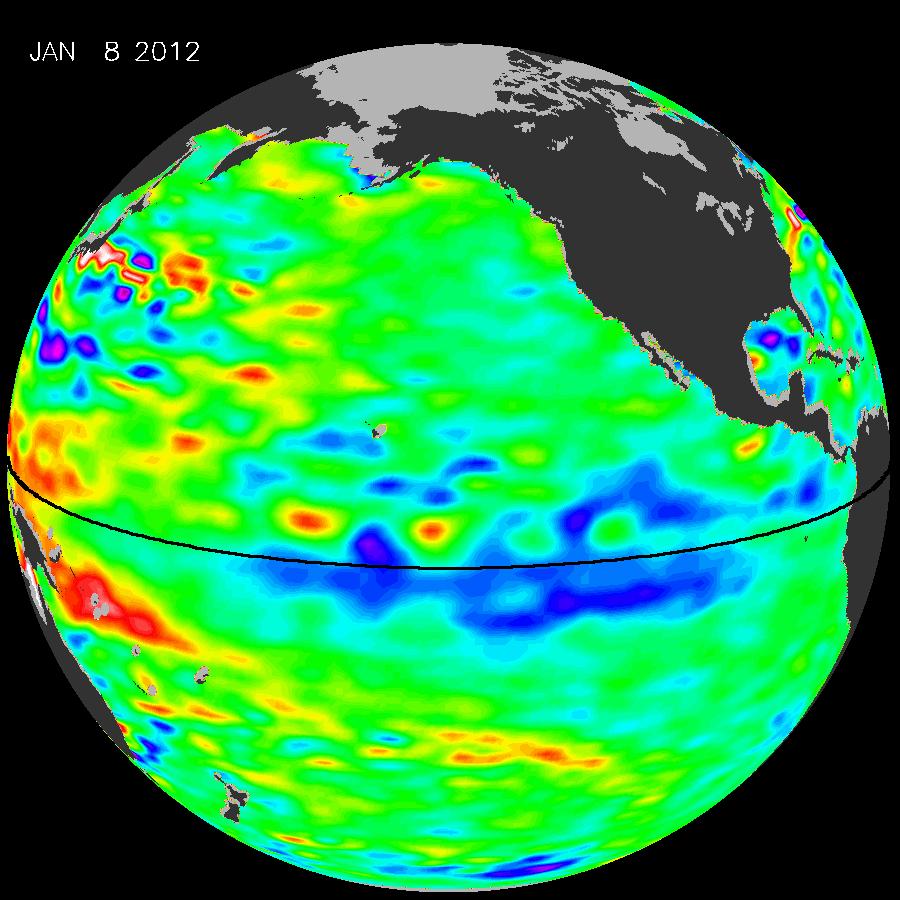
The image is based on the average of 10 days of data centered on Jan. 8, 2012. It depicts places where the Pacific sea surface height is higher than normal (due to warm water) as yellow and red, while places where the sea surface is lower than normal (due to cool water) are shown in blues and purples. Green indicates near-normal conditions. The height of the sea surface over a given area is an indicator of ocean temperature and other factors that influence climate.
This is the second consecutive year that the Jason altimetric satellites have measured lower-than-normal sea surface heights in the equatorial Pacific and unusually high sea surface heights in the western Pacific.
"Conditions are ripe for a stormy, wet winter in the Pacific Northwest and a dry, relatively rainless winter in Southern California, the Southwest and the southern tier of the United States," says climatologist Bill Patzert of JPL. "After more than a decade of mostly dry years on the Colorado River watershed and in the American Southwest, and only two normal rain years in the past six years in Southern California, low water supplies are lurking. This La Niña could deepen the drought in the already parched Southwest and could also worsen conditions that have fueled recent deadly wildfires."
Read more at NASA
NASA Study Solves Case of Earth's 'Missing Energy'
by NASA/Jan. 27, 2012
------------------------------
Two years ago, scientists at the National Center for Atmospheric Research in Boulder, Colo., released a study claiming that inconsistencies between satellite observations of Earth's heat and measurements of ocean heating amounted to evidence of "missing energy" in the planet's system.
Where was it going? Or, they wondered, was something wrong with the way researchers tracked energy as it was absorbed from the sun and emitted back into space?
An international team of atmospheric scientists and oceanographers, led by Norman Loeb of NASA's Langley Research Center in Hampton, Va., and including Graeme Stephens of NASA's Jet Propulsion Laboratory in Pasadena, Calif., set out to investigate the mystery.
They used 10 years of data -- spanning 2001 to 2010 -- from NASA Langley's orbiting Clouds and the Earth's Radiant Energy System Experiment (CERES) instruments to measure changes in the net radiation balance at the top of Earth's atmosphere. The CERES data were then combined with estimates of the heat content of Earth's ocean from three independent ocean-sensor sources.
Their analysis, summarized in a NASA-led study published Jan. 22 in the journal Nature Geosciences, found that the satellite and ocean measurements are, in fact, in broad agreement once observational uncertainties are factored in.
"One of the things we wanted to do was a more rigorous analysis of the uncertainties," Loeb said. "When we did that, we found the conclusion of missing energy in the system isn't really supported by the data."
"Missing Energy" is in the Ocean
"Our data show that Earth has been accumulating heat in the ocean at a rate of half a watt per square meter (10.8 square feet), with no sign of a decline," Loeb said. "This extra energy will eventually find its way back into the atmosphere and increase temperatures on Earth."
Read more at NASA
------------------------------
Two years ago, scientists at the National Center for Atmospheric Research in Boulder, Colo., released a study claiming that inconsistencies between satellite observations of Earth's heat and measurements of ocean heating amounted to evidence of "missing energy" in the planet's system.
Where was it going? Or, they wondered, was something wrong with the way researchers tracked energy as it was absorbed from the sun and emitted back into space?
An international team of atmospheric scientists and oceanographers, led by Norman Loeb of NASA's Langley Research Center in Hampton, Va., and including Graeme Stephens of NASA's Jet Propulsion Laboratory in Pasadena, Calif., set out to investigate the mystery.
They used 10 years of data -- spanning 2001 to 2010 -- from NASA Langley's orbiting Clouds and the Earth's Radiant Energy System Experiment (CERES) instruments to measure changes in the net radiation balance at the top of Earth's atmosphere. The CERES data were then combined with estimates of the heat content of Earth's ocean from three independent ocean-sensor sources.
Their analysis, summarized in a NASA-led study published Jan. 22 in the journal Nature Geosciences, found that the satellite and ocean measurements are, in fact, in broad agreement once observational uncertainties are factored in.
"One of the things we wanted to do was a more rigorous analysis of the uncertainties," Loeb said. "When we did that, we found the conclusion of missing energy in the system isn't really supported by the data."
"Missing Energy" is in the Ocean
"Our data show that Earth has been accumulating heat in the ocean at a rate of half a watt per square meter (10.8 square feet), with no sign of a decline," Loeb said. "This extra energy will eventually find its way back into the atmosphere and increase temperatures on Earth."
Read more at NASA
The future of human kind faces dire consequences due to arguably the first signs of dangerous climate change in the Arctic, say leading international scientists from The University of Western Australia
by The University Of Western Australia/Jan. 30, 2012
---------------------------------------
They say the Arctic region is fast approaching a series of imminent "tipping points" that could trigger an abrupt domino effect of large-scale climate change across the entire planet.
In a paper published in the Royal Swedish Academy of Sciences' journal AMBIO and a parallel commentary in Nature Climate Change, the lead author and Director of the University's Oceans Institute, Winthrop Professor Carlos Duarte, said the Arctic region contained arguably the greatest concentration of potential tipping elements for global climate change.
"If set in motion, they can generate profound climate change which places the Arctic not at the periphery but at the core of the Earth system," Professor Duarte said. "There is evidence that these forces are starting to be set in motion."
"This has major consequences for the future of human kind as climate change progresses."
Professor Duarte said the loss of Arctic summer sea ice forecast over the next four decades - if not before - was expected to have abrupt knock-on effects in northern mid-latitudes, including Beijing, Tokyo, London, Moscow, Berlin and New York.
Research showed that the Arctic was warming at three times the global average and the loss of sea ice - which had melted faster in summer than predicted - was linked tentatively to recent extreme cold winters in Europe.
Professor Duarte - winner of last year's prestigious Prix d'Excellence awarded by the International Council for the Exploration of the Sea - said the most dangerous aspect of Arctic climate change was the risk of passing critical "tipping points".
Read more at The University Of Western Australia
---------------------------------------
They say the Arctic region is fast approaching a series of imminent "tipping points" that could trigger an abrupt domino effect of large-scale climate change across the entire planet.
In a paper published in the Royal Swedish Academy of Sciences' journal AMBIO and a parallel commentary in Nature Climate Change, the lead author and Director of the University's Oceans Institute, Winthrop Professor Carlos Duarte, said the Arctic region contained arguably the greatest concentration of potential tipping elements for global climate change.
"If set in motion, they can generate profound climate change which places the Arctic not at the periphery but at the core of the Earth system," Professor Duarte said. "There is evidence that these forces are starting to be set in motion."
"This has major consequences for the future of human kind as climate change progresses."
Professor Duarte said the loss of Arctic summer sea ice forecast over the next four decades - if not before - was expected to have abrupt knock-on effects in northern mid-latitudes, including Beijing, Tokyo, London, Moscow, Berlin and New York.
Research showed that the Arctic was warming at three times the global average and the loss of sea ice - which had melted faster in summer than predicted - was linked tentatively to recent extreme cold winters in Europe.
Professor Duarte - winner of last year's prestigious Prix d'Excellence awarded by the International Council for the Exploration of the Sea - said the most dangerous aspect of Arctic climate change was the risk of passing critical "tipping points".
Read more at The University Of Western Australia
WSJ Publishes Op-Ed By 16 Scientists -- But Most Of Them Don't Actually Conduct Climate Research
Pandango: You can read the WSJ article here for a good laugh. The rebuttal is below.
---------------------------------------------------
WSJ Op-Ed Vaguely Argues Against Doing "Something Dramatic" About Climate Change. The Journal published a January 27 op-ed signed by 16 scientists and engineers, many retired, titled "No Need to Panic About Global Warming." The op-ed directs candidates for public office not to do "something dramatic" to address man-made climatechange. It then offers several fallacies -- such as 'plants love CO2' -- to dismiss the serious threats posed by climate change, compares climate scientists to Soviet scientists who "condemned to death" dissenting biologists in the 1940s, and suggests that scientists are concerned about climate change because they want "government funding for academic research and a reason for government bureaucracies to grow." Without offering any evidence, the op-ed also claims that a "growing number of distinguished scientists and engineers" believe governments should not take action on climate change. [Wall Street Journal, 1/27/12]
Most Of The Scientists Who Signed The Op-Ed Do Not Actually Publish Peer-Reviewed Climate Research. Of the 16 scientists who signed the op-ed, no more than 4 have published peer-reviewed research related to climate change, according to the Scopus database. While they may be prominent in their own fields, their credibility on the science of global warming is not comparable to that of researchers who specialize in this area. For instance, Jan Breslow is a physician, Burt Rutan is a retired airplane designer, Harrison Schmitt is a retired astronaut and former Republican politician, and Edward David is a retired electrical engineer, among others whose expertise lies elsewhere.
Read more at Media Matters
Read Joe Romm's opinion on the WSJ story at Climate Progress
---------------------------------------------------
WSJ Op-Ed Vaguely Argues Against Doing "Something Dramatic" About Climate Change. The Journal published a January 27 op-ed signed by 16 scientists and engineers, many retired, titled "No Need to Panic About Global Warming." The op-ed directs candidates for public office not to do "something dramatic" to address man-made climatechange. It then offers several fallacies -- such as 'plants love CO2' -- to dismiss the serious threats posed by climate change, compares climate scientists to Soviet scientists who "condemned to death" dissenting biologists in the 1940s, and suggests that scientists are concerned about climate change because they want "government funding for academic research and a reason for government bureaucracies to grow." Without offering any evidence, the op-ed also claims that a "growing number of distinguished scientists and engineers" believe governments should not take action on climate change. [Wall Street Journal, 1/27/12]
Most Of The Scientists Who Signed The Op-Ed Do Not Actually Publish Peer-Reviewed Climate Research. Of the 16 scientists who signed the op-ed, no more than 4 have published peer-reviewed research related to climate change, according to the Scopus database. While they may be prominent in their own fields, their credibility on the science of global warming is not comparable to that of researchers who specialize in this area. For instance, Jan Breslow is a physician, Burt Rutan is a retired airplane designer, Harrison Schmitt is a retired astronaut and former Republican politician, and Edward David is a retired electrical engineer, among others whose expertise lies elsewhere.
- WSJ Reportedly Rejected Op-Ed By 255 Members Of The U.S. National Academy Of Sciences. From a Forbes.com column by Peter Gleick, a member of the National Academy of Sciences, in response to the Journal op-ed:
But the most amazing and telling evidence of the bias of the Wall Street Journal in this field is the fact that 255 members of the United States National Academy of Sciences wrote a comparable (but scientifically accurate) essay on the realities of climate change and on the need for improved and serious public debate around the issue, offered it to the Wall Street Journal, and were turned down. [Forbes.com, 1/27/12]
Read more at Media Matters
Read Joe Romm's opinion on the WSJ story at Climate Progress
Daily Mail Fabricates Claim That There’s Been 15 Years Of No Global Warming, Despite Hottest Decade In History
by Brad Johnson/Think Progress Green/Jan. 30, 2012
------------------------------
Climate denial is now in a decadent phase of absurdity.
“Forget global warming – it’s Cycle 25 we need to worry about (and if NASA scientists are right the Thames will be freezing over again),” the Daily Mail says. “Global warming trend ended in 1997, new data shows,” the Washington Times promotes.
This is strange, since temperature data and NASA scientists show the 2000s to be the warmest decade in recorded history, significantly hotter than the 1990s.
As it turns out, the Daily Mail’s David Rose concocted the “entirely misleading” story by cherry-picking from two different press releases from the UK Met Office.
Read more at Think Progress Green
------------------------------
Climate denial is now in a decadent phase of absurdity.
“Forget global warming – it’s Cycle 25 we need to worry about (and if NASA scientists are right the Thames will be freezing over again),” the Daily Mail says. “Global warming trend ended in 1997, new data shows,” the Washington Times promotes.
This is strange, since temperature data and NASA scientists show the 2000s to be the warmest decade in recorded history, significantly hotter than the 1990s.
As it turns out, the Daily Mail’s David Rose concocted the “entirely misleading” story by cherry-picking from two different press releases from the UK Met Office.
Read more at Think Progress Green
Get Ready for Super-Extreme Weather: “We Are Just Now Experiencing the Full Effect of CO2 Emitted [by] the Late 1980s”
by Jeff Masters/Climate Progress via WunderBlog/Jan. 30, 2012
-----------------------------
The year 2011 tied with 1997 as the 11th warmest year since records began in 1880, NOAA’s National Climatic Data Center said last week. NASA rated 2011 as the 9th warmest on record. Land temperatures were the 8th warmest on record, and ocean temperatures, the 11th warmest. For the Arctic, which has warmed about twice as much as the rest of the planet, 2011 was the warmest year on record (between 64°N and 90°N latitude.) The year 2011 was also the 2nd wettest year over land on record, as evidenced by some of the unprecedented flooding Earth witnessed. The wettest year over land was the previous year, 2010.
Read more at Climate Progress
-----------------------------
The year 2011 tied with 1997 as the 11th warmest year since records began in 1880, NOAA’s National Climatic Data Center said last week. NASA rated 2011 as the 9th warmest on record. Land temperatures were the 8th warmest on record, and ocean temperatures, the 11th warmest. For the Arctic, which has warmed about twice as much as the rest of the planet, 2011 was the warmest year on record (between 64°N and 90°N latitude.) The year 2011 was also the 2nd wettest year over land on record, as evidenced by some of the unprecedented flooding Earth witnessed. The wettest year over land was the previous year, 2010.
Read more at Climate Progress
Subscribe to:
Posts (Atom)