Blog Archive

Thursday, January 26, 2012

Wikipedia Favorite: Prisoner's Dilemma

by Wikipedia
------------------

The prisoner's dilemma is a canonical example of a game, analyzed in game theory that shows why two individuals might not cooperate, even if it appears that it is in their best interest to do so. It was originally framed by Merrill Flood and Melvin Dresher working at RAND in 1950. Albert W. Tucker formalized the game with prison sentence payoffs and gave it the "prisoner's dilemma" name (Poundstone, 1992). A classic example of the prisoner's dilemma (PD) is presented as follows:
Two men are arrested, but the police do not possess enough information for a conviction. Following the separation of the two men, the police offer both a similar deal—if one testifies against his partner (defects/betrays), and the other remains silent (cooperates/assists), the betrayer goes free and the cooperator receives the full one-year sentence. If both remain silent, both are sentenced to only one month in jail for a minor charge. If each 'rats out' the other, each receives a three-month sentence. Each prisoner must choose either to betray or remain silent; the decision of each is kept quiet. What should they do?
If it is supposed here that each player is only concerned with lessening his time in jail, the game becomes a non-zero sum game where the two players may either assist or betray the other. In the game, the sole worry of the prisoners seems to be increasing his own reward. The interesting symmetry of this problem is that the logical decision leads both to betray the other, even though their individual ‘prize’ would be greater if they cooperated.

In the regular version of this game, collaboration is dominated by betraying, and as a result, the only possible outcome of the game is for both prisoners to betray the other. Regardless of what the other prisoner chooses, one will always gain a greater payoff by betraying the other. Because betraying is always more beneficial than cooperating, all objective prisoners would seemingly betray the other.
In the extended form game, the game is played over and over, and consequently, both prisoners continuously have an opportunity to penalize the other for the previous decision. If the number of times the game will be played is known, the finite aspect of the game means that by backward induction, the two prisoners will betray each other repeatedly.

In casual usage, the label "prisoner's dilemma" may be applied to situations not strictly matching the formal criteria of the classic or iterative games, for instance, those in which two entities could gain important benefits from cooperating or suffer from the failure to do so, but find it merely difficult or expensive, not necessarily impossible, to coordinate their activities to achieve cooperation.

Read more at Wikipedia

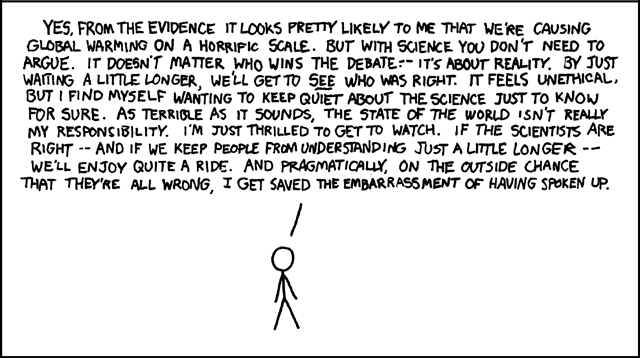
Global Warming: Let's Just Shut Up and See Who's Right

Average Middle Class Family Paying Lower Taxes under Obama

by PolitiFact/Nov. 30, 2011
----------------------------

We looked at the group’s estimate of what tax burden is borne by Americans of different income levels. The group calculates the average federal tax burden and the average federal tax rate for five quintiles of U.S. households -- or 20-percent groupings, from the top of the income scale to the bottom. These figures include the federal income tax, payroll taxes, and estate taxes, though not federal excise taxes or corporate taxes. (The tax rate figure is the "effective" tax rate -- how much the average taxpayer ultimately pays as a percentage of their cash income. It’s not a "tax bracket," which refers to the income tax rate paid on a taxpayer’s final dollar of income.)

To come up with a definition of "middle class," we ignored the top 20 percent and the bottom 20 percent and focused on the three segments of 20 percent each in the middle of the income distribution. We used the tax data for 2008 and for 2011.

So how do the numbers look? Here’s the summary.

Second-lowest 20 percent

2008 tax burden: $1,715
2011 tax burden: $1,396
Decline of $319

2008 tax rate: 6.7 percent
2011 tax rate: 5.7 percent
Decline of 1 percentage point

Middle 20 percent

2008 tax burden: $6,290
2011 tax burden: $5,535
Decline of $775

2008 tax rate: 13.6 percent
2011 tax rate: 12.4 percent
Decline of 1.2 percentage points

Second-highest 20 percent

2008 tax burden: $13,749
2011 tax burden: $13,078
Decline of $671

2008 tax rate: 17.4 percent
2011 tax rate: 16.5 percent
Decline of 0.9 percentage points

So for each of the three middle quintiles, both the amount of tax paid and the effective tax rate paid declined.
Read more at PolitiFact

A look at President Obama's fuel efficiency standards for cars and trucks

by PolitiFact/Jan. 3, 2012
-------------------

Reducing dependence

From the origins of fuel economy standards in the '70s, the policy focus has been "energy independence and security," according to NHTSA.

Some observers, such as Peter Huber and Mark Mills, authors of a 2005 book The Bottomless Well, have argued that greater efficiency doesn't actually reduce consumption. Instead, lower costs to drive simply stimulate more demand. A Boston Globe editorial this year calls energy independence "a pipe dream," saying that 35 years of such mandates haven't reversed the U.S. demand for oil. They point out highway fuel consumption has grown from 109 billion gallons in 1975 to 175 billion gallons in 2008.

Lynda Tran, spokeswoman for NHTSA, points out population growth plays a role in that change. She argues petroleum imports would need to be much higher to meet demand if the average passenger car fuel economy was still at the 1978 standard of 18 mpg and light truck fuel economy was still at the 1979 standard of 15.8 mpg to 17.2 mpg.

The last time passenger car fuel economy standards increased significantly was between 1978 and 1983, when it jumped from 18 to 26 mpg. During the same time, consumption dropped, along with imports, according to the U.S. Energy Information Administration. Meanwhile, standards didn't change much from 1983 to 2005, and consumption and imports increased — because of an increase in miles driven, Tran said.

So the new standards, Tran said, "will reduce oil imports from what they would be if there were no improvements in passenger car and light truck fuel economy."

Read more at PolitiFact

Pants on Fire: Mitch Daniels: "Nearly half of all persons under 30 did not go to work today"

Pandango: Mitch Daniels is the Indiana Gov. who gave  the Republican response to President Obama's State of the Union address.  He is not known for telling the truth.

Politifact/Jan. 24, 2012
------------------------

For December 2011, the most recent month available, we found that 44.4 percent of the 16-to-29 age group was not employed. So, Daniels is in the ballpark.

But there’s a problem: This is a ridiculous statistic to use. It includes Americans aged 16 to 18 (who are supposed to be in high school) and those 18 to 22 (many of whom are in college). If you leave high schoolers out of the equation and look only at ages 18 to 29, then the percentage who are not working declines to 37.5 percent. If you look only at ages 25 to 29, an age when most people are out of school altogether, it declines further, to 27.1 percent.

But even this is beside the point if you are trying to craft a credible statistic.
A more appropriate measure for Daniels would have been the tried-and-true unemployment rate.
The unemployment rate takes the number of unemployed people and divides it by those who are "in the labor force," which means that they are either employed or are jobless but looking for work. This measurement ignores people who are not seeking work, such as students or individuals who are raising children full-time or are unable to work for whatever reason.

These statistics offer a significantly different picture. In the broadest age range -- 16 to 29 -- the unemployment rate is 13.6 percent. For those between 18 and 29, it’s 12.9 percent. For those between 20 and 29, it’s 11.9 percent. And for those between 25 and 29, it’s 9.7 percent.

None of these measures gets Daniels any higher than 13.6 percent of the population -- far lower than the nearly 50 percent figure he cited.

Read more at Politifact

No energy industry backing for the word 'fracking'

by Jonathan Fahey/Associated Press/Jan. 26, 2012
---------------------------

NEW YORK (AP) — A different kind of F-word is stirring a linguistic and political debate as controversial as what it defines.

The word is "fracking" — as in hydraulic fracturing, a technique long used by the oil and gas industry to free oil and gas from rock.

It's not in the dictionary, the industry hates it, and President Barack Obama didn't use it in his State of the Union speech — even as he praised federal subsidies for it.

The word sounds nasty, and environmental advocates have been able to use it to generate opposition — and revulsion — to what they say is a nasty process that threatens water supplies.

"It obviously calls to mind other less socially polite terms, and folks have been able to take advantage of that," said Kate Sinding, a senior attorney at the Natural Resources Defense Council who works on drilling issues.

One of the chants at an anti-drilling rally in Albany earlier this month was "No fracking way!"

Industry executives argue that the word is deliberately misspelled by environmental activists and that it has become a slur that should not be used by media outlets that strive for objectivity.

"It's a co-opted word and a co-opted spelling used to make it look as offensive as people can try to make it look," said Michael Kehs, vice president for Strategic Affairs at Chesapeake Energy, the nation's second-largest natural gas producer.

To the surviving humans of the sci-fi TV series "Battlestar Galactica," it has nothing to do with oil and gas. It is used as a substitute for the very down-to-Earth curse word.

Michael Weiss, a professor of linguistics at Cornell University, says the word originated as simple industry jargon, but has taken on a negative meaning over time — much like the word "silly" once meant "holy."

Read more at AP

Oxnard, Pittsburgh Join Growing List of U.S. Cities Calling for Federal Action on Global Warming

by Center for Biological Diversity via Common Dreams/Jan. 25, 2012
-----------------

OXNARD, Calif. - January 25 - Oxnard, Calif., and Pittsburgh, Penn., have joined Seattle, Wash., Albany, N.Y., Boone, N.C., and other cities across the country urging the Obama administration and the Environmental Protection Agency to use the Clean Air Act to reduce carbon and other pollutants to address the increasingly urgent global climate crisis. By passing resolutions, these cities join the Center for Biological Diversity’s national Clean Air Cities campaign.

“There is no doubt that the Clean Air Act has saved thousands of lives in our country. Polluted air has terrible effects on the health of our children and all of us. This has enormous costs for our society,” said Oxnard City Council member Carmen Ramirez, who sponsored the resolution that was passed Tuesday night. “We thank all of those who have enacted and supported this law. I am proud of my city for passing this resolution."

“I’m so pleased to see Oxnard join this urgent effort to support the Clean Air Act and action on climate change now,” said Lupe Anguiano, one of the Center’s Clean Air Advocates who spearheaded passage of the Oxnard resolution. The Oxnard resolution received unanimous and bipartisan support from Mayor Dr. Thomas Holden, Mayor Pro-Tem Dr. Irene Pinkard and council members Brian MacDonald and Timothy Flynn and the City’s legislative analyst Martin Erickson, who helped draft the resolution.

“By passing these resolutions, cities like Pittsburgh and Oxnard are standing up to big polluters’ attempts to gut the Clean Air Act,” said Rose Braz, the Center’s climate campaign director. “We need to urgently reduce global warming pollution and the Clean Air Act can do that.”
Similar resolutions have also been approved in Seattle, Wash., Albany, N.Y., Tucson, Ariz., Boone, N.C., and Arcata, Richmond, Berkeley and Santa Monica, Calif. Several other cities around the country will be considering similar resolutions over the next few months.

Read more at Common Dreams

Already on the decline, will global warming hasten demise of big trees

Rhett Butler/Mongabay.com/Jan. 26, 2012
----------------------

Forest giants may suffer disproportionately from climate change, writes Laurance in New Scientist, highlighting research in La Selva, Costa Rica by David and Deborah Clark.
    "Trees are probably getting a double-whammy when the thermometer rises,' says David Clark. “During the day, their photosynthesis shuts down when it gets too warm, and at night they consume more energy because their metabolic rate increases, much as a reptile’s would do when it gets warmer.” With less energy being produced in warmer years and more being consumed just to survive, there is less energy available for growth. The Clarks’ hypothesis, if correct, means tropical forests could shrink over time. The largest, oldest trees would progressively die off and tend not to be replaced. Alarmingly, this might trigger a positive feedback that could destabilize the climate: as older trees die, forests would release some of their stored carbon into the atmosphere, prompting a vicious circle of further warming, forest shrinkage and carbon emissions.


Read more: http://news.mongabay.com/2012/0126-big_trees.html#ixzz1kcjqvJDc

Is Arctic ice at a tipping point?

by Bob Berwyn/Summit County Voice/Jan. 26, 2012
---------------------

SUMMIT COUNTY — A research effort led by the University of Colorado Boulder is launching a two-year study of Arctic sea ice to determine whether areas like the Beaufort Sea and the adjacent Canada Basin have passed a ‘tipping point’ and now are essentially sub-Arctic zones where ice disappears each summer.

Such ice loss could be causing fundamental changes in ocean conditions, including earlier annual blooms of phytoplankton, which are microscopic plant-like organisms that drive the marine food web.
The team will use unmanned aircraft and satellites to ocean buoys in order to understand the characteristics and changes in Arctic sea ice, which was at 1.67 million square miles during September 2011, more than 1 million square miles below the 1979-2000 monthly average sea ice extent for September — an area larger than Texas and California combined.

Critical ocean regions north of the Alaskan coast have experienced record warming and decreased sea ice extent unprecedented in human memory, said CU-Boulder Research Professor James Maslanik, who is leading the research effort.

The scientists will take a close look at the Beaufort Sea, considered a “marginal ice zone” where old and thick multiyear sea ice has failed to survive during the summer melt season in recent years, said Maslanik, of CU-Boulder’s Colorado Center for Astrodynamics Research in CU’s engineering college. Such marginal ice zones are characterized by extensive ice loss and a strong “ice-albedo” feedback.

Read more at Summit County Voice

Wednesday, January 25, 2012

Wikipedia Favorite: Sophie's Choice

Sophie's Choice refers to any dilemma where choosing one cherished person or thing over the other, will result in the death or destruction of the other.
Sophie's Choice can also refer to:
Source: Wikipedia

Global Warming Could Fuel Compost Bombs

by Jeremy Hsu/Live Science/Dec. 1, 2010
-----------------------

One of Earth's biggest stores of carbon dioxide sits locked within the decaying vegetation found in peatlands, which range from tropical peat swamps to Arctic permafrost. A fast-warming world could transform those peatlands into a "compost bomb" that would dump huge amounts of carbon into the atmosphere, British researchers have calculated.

A global warming rate of about 1.8 degrees Fahrenheit (1 degree Celsius) per decade will be enough to destabilize the compost if the peat is insulated from the atmosphere by dry moss or lichen, according to Sebastian Wieczorek, a mathematician at the University of Exeter in England.

Peat soils contain from 400 billion to a trillion metric tons of carbon, "which is about the same as the carbon content in the atmosphere," Wieczorek said. "A release of the soil carbon from peatlands into the atmosphere would therefore have an enormous impact on the climate system."

Read more at Live Science

This Little Piggy Made Energy (With Methane): [the scoop on poop]

by Neil Wagner/Huffington Post Green/Jan. 25, 2012
------------------------------

Researchers are also looking beyond nature's renewable resources in the quest for greener energy. Waste water, underground subways and photosynthesis are all being explored. As is, of course, poop.

Yes, poop, which is now being put to good use thanks to Duke University's new Carbon Offsets Initiative. The program, funded by Duke University, Duke Energy and Google, has been working with North Carolina's Loyd Ray Farms to process the 400,000 gallons of manure produced by the farm's 9,000 hogs each week.

The process is pretty simple. An anaerobic digester uses bacteria to consume the manure and release methane gas, which is then burned to power a 65-kilowatt microturbine. Here are some of the benefits of this carbon-neutral process:

Read more at Huffington Post Green

The Age of Fossil Energy is Far From Over

by William O'Keefe/Fuel Fix via General/Jan. 25, 2012
------------------------------

Last week, the London Sunday Times had an article about a potential discovery of methane hydrates that could more than double the world’s energy reserves. Methane hydrates are methane gas that is frozen by the high pressure and low temperatures of the deep sea. While the existence of methane hydrates is not new the potential quantities that may exist around the world is. This discovery, if they confirmed, could contain more energy than the combined known reserves of coal, oil and gas reserves. Such abundance, including the abundance of shale gas around the world, can provide an entirely new perspective on the hydrocarbon age.

Statoil, Norway’s leading gas producer, has conducted a study that suggests that methane hydrates should be considered a significant resource that could power the world for centuries. Statoil’s conclusions are consistent with work being carried out in Japan where test wells are being drilled. The Japanese company conducting the drilling claims that the first methane gas will be produced this year and the potential reserves could meet Japan’s energy needs for centuries.

Two weeks ago, Nature magazine reported that scientists from the Department of Energy will test a new technique for extracting methane from Alaska’s frozen tundra. A DOE scientist pointed out, however, that commercialization is not yet at hand. Given our abundance of natural gas, there is no urgency in rushing to adopt any technology for making methane hydrates commercial. The Japanese on the other hand are totally dependent on imports so commercialization is a much higher priority and Japan’s efforts will help to inform ours.

How soon methane hydrates will be commercially viable is anybody’s guess. We have seen other promising technologies–liquifaction, clean coal, fusion, cellulosic ethanol,etc–take decades to develop and still not be competitive. But, technology can emerge quickly and change the economics of energy development. The shale gas boom is a prime example.

There are always lessons to be learned from energy development and no doubt the growing interest in methane hydrates will provide more that a few. Some lessons, however, are not fuel specific. For example, for over a century there have been predictions that the end of the oil age was at hand. But, reserves keep growing not shrinking.

Read more at Fuel Fix

Record CO2 Reduction in US Cap & Trade States

by Susan Kraemer/Clean Technica/Jan. 24, 2012
---------------------

In yet another resounding success for cap & trade policies, today carbon dioxide pollution capped by the 10 participating RGGI states of the US Northeast has been reduced to its all-time low of a mere 124 million short tons.

Power plant CO2 emissions in the states that participate in the Regional Greenhouse Gas Initiative (RGGI) cap & trade dropped 34% below the cap in 2011, according to a new report from Environment Northeast, at Point Carbon News.

So… are they cowering in caves, like Rush Limbaugh says?
Nope. They switched to clean sources of energy. New Jersey now beats California in solar power. (Republican governor Chris Christie exited RGGI this year under pressure from the Koch brothers, but the switch was largely made already, leading to sizable drops in emissions in 2011, compared with 2005.)

RGGI auction proceeds of $440 million over the past three years – funds collected from polluters – were used to reinvest in energy efficiency subsidies which kept power consumption stable, the report said.

Ocean Acidity Exceeds Natural Norms

by Rosanne Skirble/Voice of America/Jan. 25, 2012
-----------------------------------
New research suggests an overload of carbon dioxide in the oceans is posing a serious threat to marine life, food security and tourism.

While most CO2 emissions from automobiles, buildings and factories go into the atmosphere, one-third ends up in the oceans, changing ocean chemistry and making seawater more acid.

A study in Nature Climate Change tracks ocean acidity over 21,000 years of climate history. Tobias Friedrich, co-author and post-doctoral fellow at the University of Hawaii International Pacific Research Center says the record shows natural increases in CO2 concentrations in the atmosphere over time and differences from region to region.

“This, of course, also had an effect on acidity levels in the ocean, and then (we) compared this naturally occurring increase in atmospheric carbon dioxide concentrations with man-man emissions over the last two-hundred years.”

The scientists used computer models with data from ice and ocean sediment cores to simulate ocean conditions, back to the ice age and forward to the end of the 21st century.

Read more at Voice of America

U.S. Energy Executives Believe Energy independence is Achievable within 15 Years

by Yahoo Business/Jan. 25, 2012
--------------------

NEW YORK--(BUSINESS WIRE)-- An overwhelming majority (70%) of executives at middle market energy companies see the potential for U.S. energy independence within 15 years, yet they expressed concern that the regulatory environment, along with trouble in the financial world and opposition to fracking, could dash that promise.

These are some of the findings detailed in the research study, “2012 U.S. Energy Sector Outlook” (cit.com/energyoutlook), released by CIT Group Inc. (NYSE: CIT - News) cit.com, a leading provider of financing to small businesses and middle market companies, in association with Forbes Insights.

Read more at Yahoo

The study gathered the views of more than 100 executives at middle market energy companies to assess their views on the industry and their outlook for their companies, energy prices, and trends in the coming years.

“Despite regulatory headwinds facing the industry, energy executives believe the United States can achieve energy independence within 15 years,” said Mike Lorusso, Group Head of CIT Energy. “Executives believe this drive toward energy independence will be accomplished through a combination of approaches, such as expanding the use of natural gas, increasing domestic production of oil, and expanding the use of renewable natural resources. The optimism in this industry is fueling growth ― 85% of energy executives intend to seek financing in 2012.”

Fracking complicates the climate debate

by John Kemp/Reuters/Jan. 25, 2012
------------------------

an 25 (Reuters) - Hydraulic fracturing and horizontal drilling have laid to rest concerns about peaking oil and gas supplies for a generation, but they have also made the search for comprehensive policies to restrain greenhouse gas emissions more urgent.

In a world where fossil energy remains abundant and relatively cheap the economy will combust increasing quantities. Oil and gas reserves will last long after the planet has been gently cooked unless governments enact deliberate policies to restrain consumption.

Fracking has solved one problem (peak fuel) but sharpened another (climate change). Policymakers and voters can no longer rely on increasing scarcity, and rising oil and gas prices, to restrain demand and carbon emissions through the market.


POLITICAL INACTION

Public support for policies to tackle global warming by curbing use of fossil fuels is broad but not deep. For a minority of environmentally minded voters and policymakers climate change is the over-riding priority. But for most voters and politicians climate is only one of number of competing priorities that include quotidian concerns about growth, jobs, income and quality of life.

Please read more at Reuters

Government updates growing zones for global warming

by Seth Borenstein/The Seattle Times via Associated Press/Jan. 25, 2012
----------------------------

WASHINGTON — Global warming is hitting not just home, but garden. The color-coded map of planting zones often seen on the back of seed packets is being updated by the government, illustrating a hotter 21st century.

The new guide, unveiled Wednesday at the National Arboretum, arrives just as many home gardeners are receiving their seed catalogs. The map carves up the U.S. into 26 zones based on five-degree temperature increments. But the new map will only mean "subtle changes" for Puget Sound gardeners, says Sarah Reichard, director of the University of Washington's Botanic Gardens.

You'll still face the frustration of trying to get a tomato crop, she says, and you'll still find that a hard freeze will cause havoc with those plants you bought at the nursery — plants better suited to grow in California.

Read more at Seattle Times

What do billion-dollar weather losses tell us about global warming?

by Andrew Freedman/Washington Post Capital Weather Gang/Jan. 25, 2012
-------------------------------------

In taking stock of the extreme weather of 2011, many experts (including yours truly) have pointed to the record number of “billion-dollar disasters” as evidence that the events we saw this past year were unprecedented. As the National Oceanic and Atmospheric Administration (NOAA) announced last week, there were a record 14 such events in the U.S. that caused at least $1 billion in damage, including Hurricane Irene, multiple tornado outbreaks, and Tropical Storm Lee and its associated flooding. This beat the previous record of nine billion-dollar disasters set in 2008.
But while the number of billion-dollar disasters offers insight into the increasing economic consequences of extreme weather in the United States, it does not allow us to make any firm conclusions about global warming, nor does it provide much clarity on the question of whether global warming is causing more losses from natural disasters.

As CWG’s Jason Samenow reported, the billion-dollar disaster metric is flawed, because socioeconomic changes during the past several decades outweigh any other trends. To put it simply, we’re putting more stuff in harm’s way than there used to be, causing mounting losses for the global insurance industry, and making it more likely that a severe storm will cause at least $1 billion in damage today than, say, 20 years ago.

These socioeconomic trends are taking place at the same time that global warming is beginning to manifest itself in extreme weather events, naturally leading to some confusion.

Please read more at Washington Post

Watch 131 Years of Global Warming in 26 Seconds

See the NASA video at GamerJunk.net

Policy Priority: Environmental Concern over Global Warming Polls Dead Last


Read more about this poll at PewResearchCenter

FracFocus.org: Website Reveals Chemicals Found in Fracking Fluid

Statement from the FracFocus website:

Welcome to FracFocus, the hydraulic fracturing chemical registry website. This website is a joint project of the Ground Water Protection Council and the Interstate Oil and Gas Compact Commission.
On this site you can search for information about the chemicals used in the hydraulic fracturing of oil and gas wells. You will also find educational materials designed to help you put this information in perspective.

Visit or research a well at FracFocus

Texas will disclose chemicals used in fracking

by Ben Wolfgang/Washington Times/Jan. 24, 2012
----------------------

On Feb. 1, Texas will become the latest state to require the public disclosure of all chemicals used in the controversial natural gas extraction process known as “fracking.”

The measure, viewed by critics as a small victory in the fight against what they consider a dangerous practice that threatens drinking-water supplies, will force drilling firms to post their fracking mixtures on the website fracfocus.org, an online data collection site overseen by the Ground Water Protection Council and the Interstate Oil and Gas Compact Commission.

Louisiana, North Dakota, Colorado and Montana already require such disclosures, and opponents of fracking - the use of water, sand and chemicals to crack underground rock and allow natural gas to flow freely and be captured for human use - want to see similar legislation enacted at the federal level.

Read more at Washington Times

Drought Prods Cattle Prices to High

by Marshall Eckblad & Mark Peters/WSJ/Jan. 21, 2012
---------------------

Cattle prices rose to a record as a drought in the southern Plains is beginning to bear down on the nation's beef supplies.

Faced with the worst drought since the Dust Bowl in the 1930s, ranchers in states such as Texas and Oklahoma culled their herds last year because they couldn't afford to buy feed and water to replace the parched grass and dry ponds. They sold young cattle to feedlots, where the animals are fattened before they are slaughtered and butchered.

The ripple effects of those decisions are now being felt in the cattle market, as those sales are beginning to slow. The U.S. Department of Agriculture on Friday reported that 1.68 million head of cattle were sold to feedlots in December, a 6% drop from the previous year.

Read more at WSJ

Drought reveals 1,600-year-old hidden port city in Turkey

by Mike Wehner/Tecca/Jan. 24, 2012
-------------------

Droughts are typically bad news, as they can put a strain on a country's people, economy, and infrastructure. But archaeologists are now calling a 2007 drought in Turkey a blessing, after it revealed a piece of history that will yield new information about the country's roots for decades to come.

As lack of rain caused the waters of Turkey's Lake Kucukcekmece to slowly pull away from its shore, the ancient harbor town of Bathonea revealed itself. The ruins of buildings, roads, and a sea wall are thought to date back as far as the 2nd century BC, meaning it would have been a thriving community at a time when Byzantium — now Istanbul — was a sprawling metropolis.
Please read more at Tecca

Drought, wildfires take toll on Texas tourism

Associated Press/Jan. 24, 2012
------------------------

Texas lawmakers are analyzing the effects of record-setting drought and wildfires on tourism statewide. 

The state House Culture, Recreation and Tourism Committee will hear testimony Tuesday on state parks funding and effects of the blazes and lack of rainfall on Texas' vacation industry.
In December, officials announced that wildfires, record heat and drought meant state parks received fewer visitors, causing a $4.6 million funding deficit.

Please read more at ABC Local

Natural Gas Is A Bridge To Nowhere -- Absent a Serious Price for Global Warming Pollution

by Joe Romm/Climate Progress/Jan. 24, 2012
---------------------

President of American Gas Association, 1981: “In fact, gas energy — currently America’s largest domestically produced fuel — could prove to be the keystone to solving the nation’s energy crisis by serving as the ‘bridge fuel’ to the next century’s renewable energy technologies.”
VP of AGA, 1988, “refers to natural gas as a bridge fuel — the least harmful alternative while the world looks for other, longer-lasting solutions to the ‘greenhouse’ effect,” the Washington Post reported.
Chair of AGA, 2008: “Natural gas will be the bridge fuel to the future…. The electric industry is expected to turn to natural gas as a bridge until clean coal and nuclear generation are available.”
It’s the longest bridge in history! Heck, the Golden Gate Bridge only took 4 years to build!
The President will be touting natural gas in his State of the Union address tonight, according to sources. Nothing wrong with touting gas — if you also tout a rising carbon price, which the president once did but no longer does.

Way back in June 2009, I pointed out the value of gas in the context of a climate bill with a rising CO2 price — see “Why unconventional natural gas makes the 2020 Waxman-Markey target so damn easy and cheap to meet.” But the key point of that post was that you could put gas in existing, underutilized plants to replace existing coal power cheaply to meet the key 2020 target Obama.

Building lots of new gas plants doesn’t make much sense since we need to sharply reduce greenhouse gas emissions in the next few decades if we’re to have any chance to avoid catastrophic global warming.

Please read more at Climate Progress

eHow: How Methane Generators Used on Farms Work

by Michelle Z. Donhue/eHow
---------------------------

The Process

  • Strictly speaking, the animals on a farm are the methane generators, since it is the breakdown of their waste that produces this gas used to generate electricity. Well-established farm technologies, combined with a groundswell of interest in innovative energy sources, have led to the development of several systems that can harness the passive power of escaping gases.

  • Anaerobic decomposition, or bacteria breaking down materials in the absence of oxygen, generates volumes of methane. Historically, these and other waste gases have been allowed to merely evaporate into the atmosphere. But by collecting animal waste into covered lagoons and gathering the resulting gas, the waste can fuel a heat-powered electric generator. Excess energy not used for farming purposes can be sold to the local electric utility company and distributed out to the electric grid.

  • One Lancaster, Pa. farm, which recently completed a methane collection system, houses 1,400 head of dairy cattle and 250,000 broiler chickens. By converting collected gases, the farm produces 4 to 5 megawatts of electricity every day, most of which is sold back to the grid. This amount of electricity can power up to 200 homes per day.


Read more: How Methane Generators Used on Farms Work | eHow.com http://www.ehow.com/how-does_5839767_methane-generators-used-farms-work.html#ixzz1kU8TeOuC

Methane farming draws concern from Wyoming coal industry, landowners group

by Jeremy Fugleberg/Casper Star-Tribune/Jan. 8, 2012
---------------------------


CASPER, Wyo. — A Colorado company seeking approval from federal and state agencies for methane farming in the Powder River Basin must still deal with concerns from the coal industry and a landowners group.

The Wyoming Department of Environmental Quality is considering granting a permit to Luca Technologies Inc. that would allow the company to put substances underground to encourage the growth of methane-enhancing bacteria. The U.S. Bureau of Land Management also is reviewing the company’s plans.

The bacteria are naturally present in water-saturated coal seams. They eat the coal and produce methane gas as a byproduct. Officials with Golden, Colo.-based Luca expect their process will create a slow but steady stream of gas from existing coalbed methane wells that otherwise wouldn’t produce.
Environmentalists are concerned state regulators don’t have a sufficient set of rules for the process, and the coal mining industry is concerned the method could hurt the value of coal it intends to mine.


Read more: http://billingsgazette.com/news/state-and-regional/wyoming/methane-farming-draws-concern-from-wyoming-coal-industry-landowners-group/article_fadadb34-fe0a-50a9-b126-cd2574ea68e8.html#ixzz1kU7VmlvY

Methane cleanup continues for Settler's Hill [landfill]

by Matt Brennan/Beacon-News via SunTimes/Jan. 11, 2012
---------------------------

Methane levels continue to remain stable in the Batavia area south of the Settler’s Hill landfill, according to landfill spokesman Bill Plunkett.

Waste Management is working to remove methane detected in early December in the Raddant Road and Orion Street areas of Batavia, just south of the landfill. They have three working vacuums at the landfill to bring the methane back onto the site, Plunkett said.

Read more at SunTimes

DEP investigating methane in Wyoming county water wells

by Laura Legere/The Times-Tribune/Jan. 15, 2012
---------------------------

State environmental regulators are investigating a potential case of methane gas leaching into two water wells in Nicholson Twp. and have cited a nearby gas driller for failing to report "defective, insufficient or improperly cemented casing" in three of its Marcellus Shale wells.

The Department of Environmental Protection's investigation, which began on Dec. 9 with a resident's complaint, has not yet determined the source of the methane in the two Wyoming County water wells.
On Dec. 19, regulators found 100 percent combustible gas between the cemented steel casings in three natural gas wells on Chief Oil and Gas's Polovitch well pad, according to a violation notice sent to the company on Jan. 4. State regulators view methane between a well's casings as evidence of flaws in a well's construction.

The DEP measured methane in one nearby water well at 42.1 milligrams per liter and the other at 22.1 milligrams per liter. The department has called methane levels above 28 milligrams per liter the "true level of concern" because at that point water can no longer hold the gas, which begins to escape to the air.

Methane in drinking water is not known to pose a health threat, but it can create an explosion risk if it concentrates in enclosed spaces. Sweeps of the two Nicholson homes showed no concentrated gas, and methane alarms have been installed in both homes, DEP spokeswoman Colleen Connolly said.

Chief voluntarily provided replacement bulk and bottled water to both residences and one of the homes has since hooked into a spring water supply, Ms. Connolly said.


Read more: http://thetimes-tribune.com/news/dep-investigating-methane-in-wyoming-county-water-wells-1.1257892#ixzz1kU4sx1C5

Tuesday, January 24, 2012

Wikipedia Favorite: Buridan's Ass

Buridan's ass is an illustration of a paradox in philosophy in the conception of free will.
It refers to a hypothetical situation wherein an ass is placed precisely midway between a stack of hay and a pail of water. Since the paradox assumes the ass will always go to whichever is closer, it will die of both hunger and thirst since it cannot make any rational decision to choose one over the other.[1] The paradox is named after the 14th century French philosopher Jean Buridan, whose philosophy of moral determinism it satirizes. A common variant of the paradox substitutes two identical piles of hay for the hay and water; the ass, unable to choose between the two, dies of hunger.

Buridan's principle
The situation of Buridan's ass was given a mathematical basis in a paper by Leslie Lamport, in which Lamport presents an argument that, given certain assumptions about continuity in a simple mathematical model of the Buridan's ass problem, there will always be some starting conditions under which the ass will starve to death, no matter what strategy it takes.
Lamport calls this result Buridan’s principle, and states it as:
A discrete decision based upon an input having a continuous range of values cannot be made within a bounded length of time.[2]
Read more at Wikipedia

Methane in the Twilight Zone (First Episode)

by Nathan Currier/Huffington Post Green/Jan. 11, 2012
---------------------------------

Last month saw methane emissions entering the twilight zone for the first time. By an odd quirk of timing, two incongruous things happened virtually at once. At this year's annual American Geophysical Union (AGU) conference in San Francisco, leading experts dealing with a source for potentially significant Arctic methane emissions, in an area known as the Eastern Siberian Arctic Shelf (or ESAS), gave a disturbing presentation in which they reported having recently found large plumes of escaping methane there bubbling from the sea floor, up to a hundred times larger than any they had found in the area before. Such emissions are important to watch: the carbon locked in methane hydrate (essentially frozen in an ice cage) in this one area is something like five times the carbon emitted by all human activity since industrialization, so if even a small percentage were to destabilize and out-gas to the atmosphere it could significantly alter the path of climate change.

Now, at the same time that news of their disturbing observations was starting to make waves around the climate world, methane emissions from the Arctic hit the front page of the New York Times: On the center of the front page, along with a photograph, was a feature article, "Warming Arctic Permafrost Fuels Climate Change Worries" (Justin Gilles, Dec. 16, 2011). The oddest part, though, was how the 'fuel' for those worries had been highly filtered of impurities: The very source of Arctic methane emissions being discussed by the scientists at the AGU conference was entirely left out, although the piece was clearly of such scope and length that it could easily have been included. The author later tried to explain himself at the New York Times Green blog, saying that he intended only to discuss land-based emissions, and thus left out the ESAS situation, but his explanations only seemed to make things worse, as though he didn't quite appreciate just how intertwined with each other these different emission sources are likely to become in this region -- one of the most rapidly warming on the planet.

Read more at Huffington Post Green

Methane in the Twilight Zone (Second Episode)

by Nathan Currier/Huffington Post Green/Jan. 17, 2012
-------------------------

The most important paper on climate change in quite a while was published two days ago in Science (Shindell et al, 2012: read about it here). But sorry, folks, we don't have time to discuss it now. We've got to get back down -- way down, into the twilight zone, where the methane is leaking. Things started to get weird as we began our descent last episode.

Now, we all know, the darkest twilight is found in the human mind. Last week, David Archer -- an important climate scientist and major contributor to the highly authoritative blog RealClimate -- suddenly jumped with a big splash into the recently spreading methane swamp, posting there his "Much Ado About Methane." Archer is a brilliant scientist and has contributed important work to understanding long-term climate impacts (showing that a significant amount of the carbon we put into the atmosphere as carbon dioxide will remain there for more than 100,000 years). Here, well, he's got an original theme! Tragi-comic, yet with Zen-like austerity, too.

The central theme of Archer's play, twisted like the plot of a Shakespearean comedy, is this: since methane is oxidized in the atmosphere by photochemical reactions to carbon dioxide (and water vapor), and the carbon in that carbon dioxide essentially lasts forever, bouncing around for 100,000 years, even a very large excursion of methane doesn't really make methane important (it plays the central character here of 'Nothing'), because the carbon dioxide the methane oxidizes to has about as great an impact as the methane, when integrated over 100,000 years!

Read more at Huffington Post Green

U.S. CO2 emissions to stay below 2005 levels as coal use shrinks

by Reuters/Jan. 24, 2012
------------------------


NEW YORK - U.S. energy-related CO2 emissions will be 7 percent lower than their 2005 level of nearly 6 billion metric tons in 2020 as coal's share of electricity production continues a steady descent over the next two decades, according to new government data.

The Energy Information Administration (EIA) released an early version of its annual energy outlook on Monday, which predicted a slowdown in growth of energy use over the next two decades amid economic recovery and improved energy efficiency.

The report highlights the fact that carbon-intensive coal generation will see a major decline in the power sector in the coming decades, which will ensure energy-related CO2 emissions will not exceed 2005 levels at any point before 2035.

The report also showed that emissions per capita would fall an average of 1 percent per year from 2005 to 2035 as the new federal standards, state renewable energy mandates and higher energy prices would temper the growth of demand for transportation fuels.

Please read more at Reuters

Bulgaria Bans Fracking, Thwarting Chevron Drilling Plan

by Elizabeth Konstantinova and Joe Carroll/Businessweek via Bloomberg/Jan. 18, 2012
------------------------------------

Jan. 18 (Bloomberg) -- Bulgarian lawmakers banned hydraulic fracturing and established a 100 million-lev ($65 million) fine for offenders, thwarting Chevron Corp.’s plans to explore for natural-gas deposits in the Balkan country.

Lawmakers voted 166-6 to prohibit the drilling technique known as fracking. That makes Bulgaria the second country in the European Union after France to ban the process, which uses a mixture of water, sand and chemicals to open fissures in shale rocks and release gas and oil.

The prohibition will “seriously impair” Bulgaria’s efforts to reduce its reliance on Russian gas, Ivan Kostov, the leader of the opposition Democrats for Strong Bulgaria, said in parliament. Bulgaria may hold 300 billion to 1 trillion cubic meters of shale gas, the Energy & Economy Ministry has estimated. The country consumes about 4 billion cubic meters of gas a year.

Please read more at Businessweek

Could Fracking Earthquakes Shake Pennsylvania?

by Susan Phillips/NPR/Jan. 23, 2012
----------------------------

The New Year’s Eve earth­quake that shook Youngstown, Ohio mea­sured 4.0 on the Richter scale. The tem­blor was the largest of a series of quakes that had been rock­ing the area around Youngstown for sev­eral months and are blamed on a deep injec­tion well. No frack­ing hap­pens at deep injec­tion wells. But frack­ing waste­water is sent down those wells at high pres­sure as a method of disposal.

Researchers at Colum­bia University’s Lamont-Doherty Earth Obser­va­tory have stud­ied the earth­quakes in Ohio and iden­ti­fied the deep well they think caused the quake. The Youngstown well went into a sand­stone for­ma­tion, and then 300 feet fur­ther into more solid rock. John Arm­bruster, a seis­mol­o­gist with Lamont-Doherty, says the sand­stone in that area is not very porous.

“The sand­stone doesn’t want to accept this waste very eas­ily,” says Arm­bruster. “So you have to use a lot of pres­sure to force the waste into the sandstone.”

When that pres­sur­ized fluid came in con­tact with a fault, the earth started to shake. Arm­bruster says it’s unlikely that the sand­stone itself would have trig­gered a quake. But he says the Youngstown well was sunk deeper, into harder rock lay­ers, where earth­quakes were wait­ing to happen.
“The energy needs to be there,” says Armbruster.
Please read more at NPR

How Fracking is Changing the Face of South Texas

Pandango: It's always about the money.

by Dave Fehling/NPR/Jan. 24, 2012
--------------------------

Rancher Tim Pennell says you need only look out the window in DeWitt County to see what “fracking” has brought to the gently rolling terrain of South Texas.

“If you want to work, you come to DeWitt County and you can damn sure get a job,” said Pennell.
Fracking is helping create a gusher of jobs as evidenced by the the line of oil field workers at a barbecue stand that operates along the road next to Pennell’s house. A few hundred yards away, a drilling rig is running 24/7.

Rancher Tim Pennell says you need only look out the window in DeWitt County to see what “fracking” has brought to the gently rolling terrain of South Texas.

“If you want to work, you come to DeWitt County and you can damn sure get a job,” said Pennell.
Fracking is helping create a gusher of jobs as evidenced by the the line of oil field workers at a barbecue stand that operates along the road next to Pennell’s house. A few hundred yards away, a drilling rig is running 24/7.

Fracking, or hydraulic fracturing, uses millions of gallons of water per drilling operation, mixing the water with sand and chemicals, then injecting it into the ground to force out oil and gas from the rocky shale thousands of feet underground. It is highly controversial. Bulgaria has now joined France in banning it, and temporary bans are in place in New York and New Jersey.

Please read more at NPR

U.S. Military:Climate change is a 'National Security Threat'

by Tim Rinne/Journal Star/Jan. 21, 2012


Every four years, the Department of Defense issues a congressionally mandated "Quadrennial Defense Review" framing the Pentagon's strategic choices and establishing priorities to determine appropriate resource investments. In February 2010, for the first time, climate change was formally designated in the QDR as a "National Security Threat."

Climate-related changes, from increases in heavy downpours and rises in temperature and sea levels to rapidly retreating glaciers, thawing permafrost and earlier snowmelt "are already being observed in every region of the world, including the United States and its coastal waters," the QDR notes. It warns that "climate change will contribute to food and water scarcity, will increase the spread of disease, and may spur or exacerbate mass migration. While climate change alone does not cause conflict, it may act as an accelerant of instability and conflict ..."

The 2010 QDR also addresses the fact the Defense Department is itself the world's largest consumer of fossil fuels and, correspondingly, the greatest emitter of greenhouse gases. In the review, the Pentagon pledges to dramatically reduce its own carbon footprint through increased energy efficiency and major investments in renewable energy.

The Republican Party for decades has styled itself as the party of national defense and military strength. Yet debunking the international scientific consensus on climate change has become a veritable article of faith among Republican candidates and officeholders. That position puts the GOP squarely at odds with the military establishment, which has unequivocally accepted the scientific conclusions of the 97 percent of the world's climatologists who actually conduct research on climate and publish in journals reviewed by their peers.

This past November, the Pentagon's Defense Science Board released its own study, "Trends and Implications of Climate Change for National and International Security." The study asserts that "climate impacts are observable, measurable, real, and having near and long-term consequences." Failure to anticipate and mitigate these changes, the report argues, "increases the threat of more failed states with the instabilities and potential for conflict inherent in such failures."


Read more: http://journalstar.com/news/opinion/editorial/columnists/local-view-u-s-military-global-warming-is-real/article_da07086c-e767-58b4-9258-24196cdecf03.html#ixzz1kRCJlcOQ

NASA video shows global warming is real

by Tuan C. Nguyen/Smart Planet/Jan. 24, 2012
---------------------------

If there were any doubt that a real warming trend is upon us, scientists at NASA have produced a visualization that depicts the recent rise in global temperatures as felt over a span of 130 years.
While the video shows a clear pattern of seasonal temperature changes along with momentary spikes throughout the centuries, you can see that it’s only recently that temperatures in most regions of the world (represented with intensified colors) started to really peak. In fact, since the year 2000, we’ve experienced nine of the 10 warmest years on record. And the researchers have noted that within the past 11 years, temperatures were significantly hotter than in the middle and late 20th century. For instance, the average temperature globally in 2011 was 0.92 degrees F (0.51 C) warmer than baseline temperatures in the mid-20th century.

The warmest years on record were 2005 and 2010, registering as a virtual tie.

“We know the planet is absorbing more energy than it is emitting,” said James E. Hansen, Director of NASA’s Goddard Institute for Space Studies. “So we are continuing to see a trend toward higher temperatures. Even with the cooling effects of a strong La Niña influence and low solar activity for the past several years, 2011 was one of the 10 warmest years on record.”

Related: Interactive map reveals effects of climate change in your neighborhood

The weather data was culled from more than 1,000 meteorological stations around the world, satellite measurements of sea surface temperature and recordings from an Antarctic research station.

Please visit Smart Planet to view the video

Climate Science Education: It's Important

by Rebecca Anderson/Huffington Post/Jan. 24, 2012
----------------------------

This week, an article came out in the LA Times describing climate change education as the new "evolution debate" in schools, reporting that some states are considering new policies that would require teachers to "teach climate change denial as a valid scientific position."

ACE was founded to fill an enormous gap in our educational sciences curriculum around this very subject. Currently, there are no state or national science standards in public high schools that address teaching of the science of global warming, even though 98 percent of the world's climate scientists agree that humans are causing climate change, and the consequences could be extraordinary.

In 2009, ACE amassed a team of the best educators, communicators, and creative minds in the country to develop a 45-minute multimedia assembly presentation that explains basic climate science in a way that sticks with high school students. We take an issue that could be complex and ground students in the most current science, drawn from the U.N. Intergovernmental Panel on Climate Change (IPCC).

We felt young people deserved to know what nearly all climate scientists understand -- and we set out to help communicate their scientific conclusions to our nation's youth. In just 2 years, ACE has reached over 1 million students nationwide.

Read more at Huffington Post

January 24 News: 2012 Outlook for American Coal is “Grim”

by Stephen Lacey/Climate Progress/Jan. 24, 2012
--------------------

Coal Industry Losing Steam

This year’s outlook is grim for the U.S coal industry, which after two years of rising profits has begun closing mines, signaling a new wave of production cutbacks and, possibly, another round of industry consolidation.

The country’s biggest coal producers, which begin reporting fourth-quarter results on Tuesday with St. Louis-based Peabody Energy Corp., should provide insight into how bad this year could be. Most should meet Wall Street’s earnings expectations for the last quarter of 2011 on export gains over a year ago, while tempering investor expectations for 2012, say analysts.

Read more at Climate Progress

Book Publisher Sends All 308 Members Of Canada's Parliament A Book About Global Warming

Pandango: I wonder how many MP's just threw that book in the trash?

by Cathryn Wellner/care2.com/Jan. 23, 2012
---------------------------

When Canada pulled out of the Kyoto Accord at the Durban Conference on Climate Change, Orca Book Publishers figured our politicians needed some educating on the realities of climate change. So the company sent copies of “Generation Us – The Challenge of Global Warming” to all 308 Members of Parliament.

Orca’s publisher, Andrew Woolridge, said in the company’s press release:

We’re concerned that too many of our politicians see climate change as a political problem, not the threat that it is to the very survival of future generations. Hopefully the book will provide a more complete analysis of the problem for at least some of our elected representatives.

“Generation Us” was written by University of Victoria professor Andrew Weaver, whose credentials are impeccable. The renowned climatologist is Canada Research Chair in climate modeling and analysis in the School of Earth and Ocean Sciences, team member of the Intergovernmental Panel on Climate Change, and author of “Keeping Cool: Canada in a Warming World.”


Read more: http://www.care2.com/causes/publisher-to-mps-read-this-and-stop-ignoring-climate-change.html#ixzz1kR32z9t2

Monday, January 23, 2012

Wikipedia Favorite: Information Overload

"Information overload" is a term popularized by Alvin Toffler in his bestselling 1970 book Future Shock. It refers to the difficulty a person can have understanding an issue and making decisions that can be caused by the presence of too much information.[1] The term itself is mentioned in a 1964 book by Bertram Gross, The Managing of Organizations.[2]

The term and concept precede the Internet and can be viewed from a library and information sciences perspective[3] or viewed as a psychology phenomenon.[4] In psychology, information overload relates to an overabundance of incoming information into the senses.[4] Toffler's explanation of it presents information overload as the Information Age's version of sensory overload, a term that had been introduced in the 1950s.[5] Sensory overload was thought to cause disorientation and lack of responsiveness. Toffler posited information overload as having the same sorts of effects, but on the higher cognitive functions, writing: "When the individual is plunged into a fast and irregularly changing situation, or a novelty-loaded context ... his predictive accuracy plummets. He can no longer make the reasonably correct assessments on which rational behavior is dependent."[6]

As the world moves into a new era of globalization, an increasing number of people are connecting to the Internet to conduct their own research[7] and are given the ability to produce as well as consume the data accessed on an increasing number of websites.[8][9] Users are now classified as active users[10] because more people in society are participating in the Digital and Information Age.[11] More and more people are considered to be active writers and viewers because of their participation.[12] This flow has created a new life where we are now in danger of becoming dependent on this method of access to information.[13][14] Therefore we see an information overload from the access to so much information, almost instantaneously, without knowing the validity of the content and the risk of misinformation.[15][16]

According to Sonora Jha of Seattle University, journalists are using the Web to conduct their research, getting information regarding interviewing sources and press releases, updating news online, and thus it shows the gradual shifts in attitudes because of the rapid increase in use of the Internet.[17] Lawrence Lessig has described this as the "read-write" nature of the internet.[18]

Please read more at Wikipedia

Environmentalists see reason for alarm in GOP race

by Associated Press/Jan. 23, 2012
----------------------

(AP) WEST PALM BEACH, Fla. — Four years after the GOP's rallying cry became "drill, baby, drill," environmental issues have barely registered a blip in this Republican presidential primary.

That's likely to change as the race turns to Florida.

The candidates' positions on environmental regulation, global warming as well as clean air and water are all but certain to get attention ahead of the Jan. 31 primary in a state where the twin issues of offshore oil drilling and Everglades restoration are considered mandatory topics for discussion.

"It's almost like eating fried cheese in Iowa," said Jerry Karnas of the Everglades Foundation. Drilling has long been banned off Florida's coasts because of fears that a spill would foul its beaches, wrecking the tourism industry, while the federal and state governments are spending billions to clean the Everglades.

Though most expect the candidates to express support for Everglades restoration — as Mitt Romney did in his 2008 campaign — environmentalists are noting a further rightward shift overall among the GOP field. The candidates have called for fewer environmental regulations, questioned whether global warming is a hoax and criticized the agency that implements and enforces clean air and water regulations.

Please read more at CBS News

Global warming activists launch misguided campaign against skeptical TV weathercasters

Pandango: I see the authors point on this story...  I don't agree with it, but I do understand his point.  Seeing as how it is so difficult to change the mind of a skeptic, and seeing as how the message of the skeptic is being echoed throughout the media and confusing the general public, it is only best to go on without them and make policy decisions and policy statements based on those who understand the science instead of from those who only want to confuse the science.  The skeptic cannot recognize the background noise from the tune.  Weathermen are some of the worst out there muddying the waters.  We neeed to move on without them.  They can live in denial.  We need to move along rather than trying to produce more converts.  Let them sink with the ship, or we will all sink with them.
----------------------

by Jason Samenow/Capital Weather Gang via Washington Post/Jan. 23, 2012


If you present the weather on TV and you reject that global warming is the result of human activities, the spotlight on you is hotter than ever. But the attention is a colossal waste of energy.

Coinciding with this week’s American Meteorological Society Annual Meeting in New Orleans, the groups 350.org, the League of Conservation Voters, and the Citizen Engagement Lab have launched a campaign that exposes television weathercasters who take a contrarian stance on climate change science.

The campaign, called Forecast the Facts, launched a website that identifies 47 TV weathercasters by name who have publicly expressed climate change views considered outside of the mainstream. (It is also pressuring the American Meteorological Society to strengthen its position statement on the science.)

This confrontational approach is the wrong approach and promises to only further divide TV weathercasters whose views on the issue of climate change are already polarized.

Read more at Washington Post