 |
| Not this ass. |
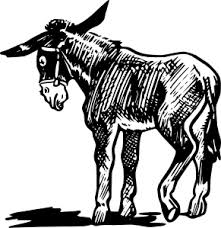 |
| This ass. |
An ass sits equidistant between two bales of hay. Both bales of hay are equal in size and amount, and both bales look equally as tempting to eat. The ass, not sure which bale of hay to eat first, is paralyzed by indecision, and eats nothing - starving to death. Such is the philosophy of
Buridan's ass.
This happens a lot in politics. Both political sides seem to have equally good reasons for enacting or not enacting an important policy decision. The public, too busy to really get into all the details, reads headlines and brief stories about the policy, trusting that what they are reading is factual and trustworthy. Polls start to show that the public is divided over an issue, or not interested, and the government becomes paralyzed - incapable of making a decision.
Depending on where the public gets its news, there can be very different information presented on an issue. Sometimes unfortunately, the information is not factual or it's partially factual, but taken out of context to mean something completely different than what it was originally intended to mean. The information becomes twisted and obscured to only benefit a particular group, business or political party.
Another source of news might be more ethical, and present the same information the way it was originally intended. It's listeners or readers understand the issue more clearly, and realize that a "better" option is probably out there, or at least one that is better than status quo.
Sometimes strong, decisive, and quick action should be taken in order to avoid any more harm. The U.S. deciding to become involved in WWII after the bombing of Pearl Harbor might be seen as one of those instances. But the longer an issue is allowed to be debated and heard and judged by the public, the less of a chance it has of ever being acted on in a positive and beneficial way. Many issues reported by the media deals with the future of the status quo i.e. energy, health care, social programs, environment... Status quo, many times, represents a strong force in the business and political world that has great influence, but whose time has come for them to fade into the past rather than becoming a part of the future, but since their future is threatened, they try to do all they can to keep their power, wealth and influence.
The media has a lot of influence in this matter. Millions of viewers watching a popular news program is nothing to sneeze at, especially if the viewers trust their news source. Using the media to shape and influence power struggles is how a democracy controls its people. Those in power must make those not-in-power,believe that their way is the "best" way. How is that done? By presenting information through the media that best represents their (business or political hacks) interest, but in a way that seems like it is in the best interest of the people, when in actuality it is much better for businesses or politicians. The only problem is that there are those who will think more critically about an issue, not believe the source, and go somewhere else for their information. So what can be done to counter what the other side is saying?
Well, both sides pump out information as fast as they can to show that they are "correct" and the other side is "wrong" and craftily leave it up to the public to decide. One side shows evidence to prove they are correct, but immediately the other side shows that the "evidence" is not what it was believed to be, and that it should be interpreted another way. So the score remains the same, the public becomes either "fatigued" or divided over the issue and nothing is done. In the case of politics and business, status quo and nothingness is a victory. Going ahead with business as usual is good for a business or political party that stands to gain by things remaining the same. That is why information about a certain policy or issue must seem "equal" in the public's eye. In other words, there should be just as much information saying it is a good policy as there is information saying it's not a good policy. Some might say, "Oh, your source says this? Well, my source says the exact opposite". It doesn't matter if the information is correct or factual, as long as it "seems" that the there is just as much information "supporting" it as there is "against " it. If the business who has the most to gain (and lose) can cause paralysis in the eyes of the public and government policy makers then the business wins by default. Inaction and status quo rule the day even though the "issue is still being debated".
But there is a reason why Buridan had his ass starve to death in his story. Being paralyzed on important policy issues is not a good thing. Doing nothing can result in terrible consequences. The further away from equilibrium you get, the worse things will become. Buridan would say that if you don't know which way to go on an issue, you should try and at least go the way that is most "correct". The further away you get from what is correct, the further away you get from balance and harmony.
If the input of information by the media and politicians eventually reaches an input level where a proper decision cannot be made, metastability will result, causing chaos and public policy failure. The more one moves away from the proper choice that should have been made, the more likely metastability will occur. Making an arbitrary decision in regards to a distorted issue >>>>>>> leads to more ambiguous choices >>>>>>>> leading one closer and closer to >>>>>> dysfunctional and terrible consequences.
Just to make clear, the purpose of this writing is to inform the reader on how and why information is used to produce paralysis and inaction in the public and government. The Climate Change issue is a perfect example of how information has been used and distorted to prop up the status quo in favor of dirty energy and harmful environmental policies. The propaganda has been powerful, the people and government divided, and the consequences could be terrible unless something is done.
Thanks for reading...


